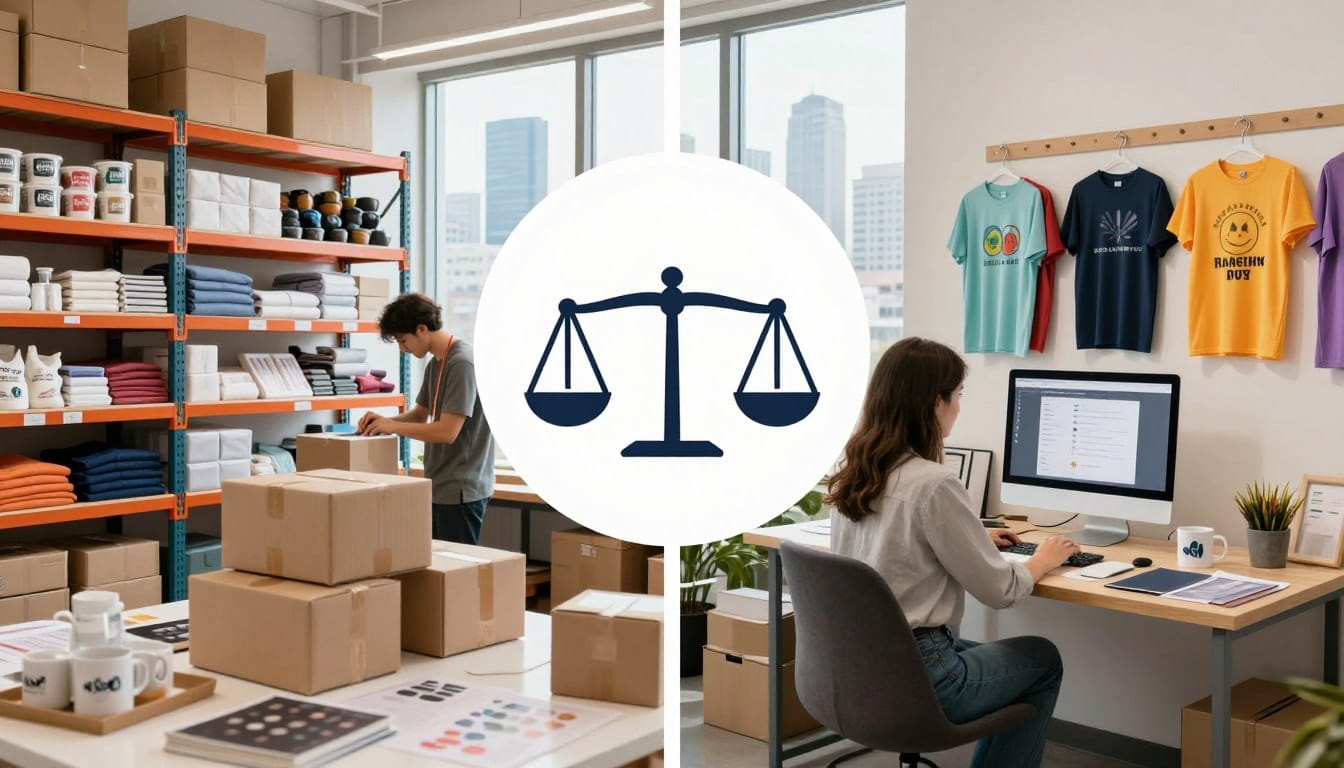


Choosing the right business model can be a daunting task for aspiring ecommerce entrepreneurs. Among the most accessible options are two popular methods: dropshipping and print-on-demand. Both models allow you to start an online business without the need for significant upfront inventory investment. This makes them low-risk entry points into the world of ecommerce.
The main difference lies in how much control you want over product customization and branding. Print-on-demand offers more creative freedom, while dropshipping provides access to a vast catalog of ready-made products. This article will offer a comprehensive, side-by-side comparison of these two models. Our goal is to help you make an informed decision based on your goals, skills, and resources.
Understanding the nuances between these models is essential. The right choice can significantly impact your profit margins, branding opportunities, and long-term scalability. Both rely on third-party suppliers for fulfillment, but they differ in inventory management, product selection, and customer service. By the end of this article, you will have a clearer understanding of which model aligns best with your entrepreneurial vision.
Many successful online businesses actually combine elements of both models to diversify their offerings. Remember, there is no universally correct answer; the best choice depends on your individual business objectives and creative inclinations.
Key Takeaways
- Both models eliminate the need for upfront inventory investment.
- Customization and brand control differ significantly between the two.
- Understanding these models is crucial for profit margins and scalability.
- Both methods rely on third-party suppliers for fulfillment.
- Many businesses successfully blend elements of both models.
Understanding the User Intent Behind “Dropshipping vs Print-on-Demand: Which Is Better”
For many new entrepreneurs, deciphering the best ecommerce model can be challenging. They often seek clarity in a sea of information. Understanding the user intent behind the search for comparisons between dropshipping and print-on-demand is essential. This search is not just about choosing a model; it reflects a desire for knowledge and guidance.
Informational Purpose and Target Audience
The primary audience for this comparison includes aspiring ecommerce store owners, side-hustlers, and creative professionals. These individuals want to launch an online business without significant capital investment. They are typically beginners or intermediate entrepreneurs looking for a clear, comparative guide to these two fulfillment methods.
What Readers Want to Learn
Readers are eager to grasp the fundamental differences between dropshipping and print-on-demand. They want to know about startup costs, profit potential, and day-to-day operational requirements. Many experience analysis paralysis, feeling overwhelmed by conflicting information. A structured, authoritative comparison can help them move forward.
Additionally, many are looking to determine which model offers a faster path to profitability. They want insights that align with their existing skills, whether in creative design or marketing. Practical, actionable insights are valued over theoretical concepts. Readers seek real-world examples of successful businesses utilizing each model.
Understanding the risks and challenges associated with each model is also crucial. Issues like supplier reliability, product quality concerns, and market saturation can impact their decisions. The long-term sustainability of each model is another important factor. Readers are not just looking for quick profits; they want a viable business they can scale over time.
Some readers aspire to build a unique brand identity through custom designs. Others prefer to capitalize on trending products without creative involvement. By understanding this user intent, the article can deliver the precise information needed for readers to make a confident, well-informed decision.
Defining Dropshipping and Print-on-Demand Business Models
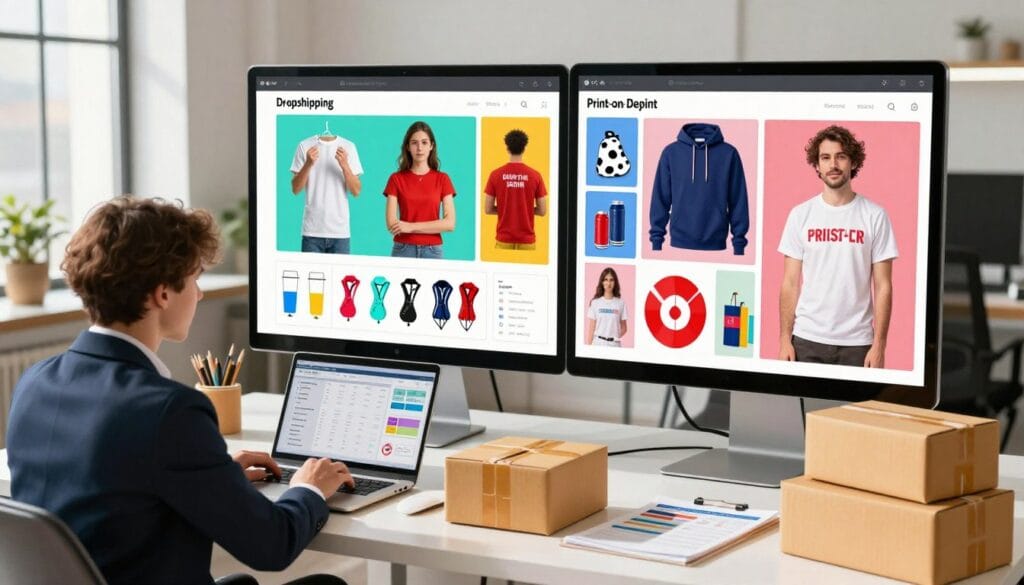
Understanding the fundamentals of each business model is crucial for aspiring online retailers. These two methods provide unique pathways for entrepreneurs to enter the ecommerce space without heavy investments.
What Is Dropshipping?
Dropshipping is a retail fulfillment method where the seller does not keep products in stock. Instead, when a customer places an order, the seller transfers the order details to a third-party supplier. This supplier then ships the products directly to the customer. This process allows store owners to offer a wide range of products without the need for inventory management.
What Is Print-on-Demand (POD)?
Print-on-demand is a specialized form of dropshipping. In this model, products are customized with unique designs only after a customer places an order. This means that business owners can sell personalized merchandise without holding any inventory. Popular items include custom t-shirts, mugs, and phone cases, allowing for creative expression without financial risk.
How Both Models Fulfill Orders
The order fulfillment process differs significantly between these two models. In dropshipping, the store owner lists products from dropshipping suppliers. When a customer places an order, the supplier picks, packs, and ships the ready-made item directly to the customer.
In contrast, the print-on-demand process begins when an order is confirmed. The supplier prints the custom design onto a blank product, then handles the packaging and shipping. This model emphasizes the uniqueness of each item, catering to niche markets.
Both business models eliminate the need for warehousing and upfront product investment. This accessibility makes them attractive options for entrepreneurs with limited capital. However, the key operational difference lies in the type of products offered. Dropshipping focuses on pre-manufactured items, while print-on-demand specializes in made-to-order products that reflect the seller’s creativity.
By understanding these foundational definitions, entrepreneurs can better assess which model aligns with their business goals and creative vision.
Initial Startup Costs: Comparing Dropshipping and Print-on-Demand
The initial investment required can greatly influence your choice of business model. Both options are celebrated for their low barriers to entry, allowing entrepreneurs to start without purchasing inventory upfront. This dramatically reduces the financial risk compared to traditional retail.
For a dropshipping business, the primary startup costs typically include:
- Setting up an online store on platforms like Shopify.
- Purchasing a domain name.
- Investing in product research tools and initial advertising campaigns to test winning products.
Entrepreneurs often allocate a budget for product testing. They may use platforms like Facebook Ads or Google Ads to identify high-demand items before scaling. This can be a significant but necessary expense.
On the other hand, print-on-demand startup costs also include similar ecommerce platform fees. However, they may require additional investments such as:
- Hiring freelance designers from platforms like Fiverr or Upwork.
- Learning design software like Adobe Illustrator or Canva.
It’s crucial for print-on-demand sellers to order product samples. This ensures quality and enhances the overall customer experience before launching their store. While this adds to initial costs, it is vital for building a strong brand reputation.
Branding expenses for print-on-demand can encompass:
- Custom packaging.
- Logo design.
- Building a cohesive visual identity across the website and social media.
In contrast, these branding elements are less critical in generic dropshipping models. Reports indicate that dropshipping businesses can increase profitability by up to 50% by lowering operational costs. This allows for reallocating savings into marketing efforts.
When comparing cost structures, dropshipping often requires more spending on advertising and product research tools. Meanwhile, print-on-demand may necessitate more investment in creative assets and sample orders.
Both models enable entrepreneurs to start with minimal capital, often less than $500. This makes them viable options for bootstrapped startups. Ultimately, it’s essential to consider personal skills and budget allocation preferences when evaluating which model’s startup costs align with your resources.
| Cost Category | Dropshipping | Print-on-Demand |
|---|---|---|
| Initial Store Setup | Low (Shopify fees, domain) | Low (Shopify fees, domain) |
| Product Research Tools | Moderate | N/A |
| Advertising | Moderate to High | Low to Moderate |
| Design Costs | N/A | Moderate (freelancers, software) |
| Sample Orders | N/A | Essential |
| Branding Expenses | Low | Moderate to High |
Risk Level and Challenges in Each Business Model
Navigating the complexities of ecommerce models can present unique challenges for entrepreneurs. Understanding the risks associated with both print-on-demand and dropshipping is crucial for long-term success. Each model has its own set of challenges that can impact customer satisfaction and business reputation.
In the print-on-demand model, the primary risk lies in the appeal and demand of the designs. If a product doesn’t resonate with customers, the time and resources spent on design and marketing can be wasted. Although there is no financial loss from unsold inventory, the effort invested may not yield returns.
Additionally, print quality inconsistencies can arise. Variations between digital mockups and the final product can lead to customer dissatisfaction. Long fulfillment times, inherent in the made-to-order process, can further affect customer experiences. Therefore, selecting a reliable print-on-demand provider is essential. Reputable companies like Printful or Printify have established quality control processes that help mitigate these risks.
Risks in Print-on-Demand Related to Design Appeal and Quality
- Market appeal is crucial; poor design choices can lead to zero sales.
- Inconsistencies in print quality may affect customer satisfaction.
- Longer fulfillment times can lead to frustration among customers.
On the other hand, the dropshipping model carries its own set of risks, primarily related to supplier reliability. Since products are sourced from dropshipping suppliers, sellers have limited control over product availability and quality. A sudden stock shortage or shipping delay can result in unhappy customers, leading to refunds and disputes.
To minimize these risks, dropshipping entrepreneurs should diversify their suppliers. Setting clear expectations regarding shipping times on product pages can also help manage customer expectations. Market saturation is another challenge; many stores sell identical products, which can lead to price wars and reduced profit margins.
Dropshipping Risks: Supplier Reliability and Inventory Management
- Supplier reliability is crucial; stock shortages can damage your reputation.
- Limited control over fulfillment processes can lead to customer dissatisfaction.
- Market saturation can diminish profit margins and increase competition.
Both business models offer low financial risk compared to traditional retail. However, operational risks differ significantly and require proactive management. Understanding these risks is essential for building a resilient and sustainable online business.
As a print-on-demand seller, testing multiple design concepts and gathering customer feedback can reduce design risks. In contrast, dropshipping businesses should utilize inventory synchronization tools to keep track of stock levels and ensure a smooth customer experience.
“Understanding and preparing for these risks is essential for building a resilient and sustainable online business.”
Inventory and Order Management in Dropshipping vs Print-on-Demand
Effective inventory management is essential for success in ecommerce. Understanding the differences in how each model handles inventory and orders can help you make informed decisions for your online store.
Print-on-Demand Made-to-Order Process
In the print-on-demand model, products are made to order. This means there is no need to worry about stock shortages. Suppliers print and fulfill orders as they come in, which significantly reduces the risk of overproduction.
However, this process can lead to longer fulfillment times. Each item is produced from scratch before being shipped, typically taking about 2 to 7 business days for production, plus shipping time. Therefore, it’s crucial to partner with a reliable print-on-demand supplier. A good supplier will have efficient production workflows and multiple fulfillment centers to speed up delivery times.
For example, Printful has fulfilled over 99.5 million custom products since 2013. With a diverse catalog of apparel, home decor, and accessories, they help online businesses sell personalized items efficiently.
Dropshipping Inventory Synchronization and Supplier Coordination
On the other hand, managing inventory in dropshipping can be trickier. Sellers rely on third-party suppliers to store and ship ready-made products. This reliance means there’s always a risk of items going out of stock, especially if multiple businesses source from the same supplier.
To minimize these risks, many dropshipping businesses utilize automation tools. Apps like Oberlo, DSers, or Syncee can sync supplier inventory with your online store in real time. This ensures that product availability is always up to date, reducing the chances of canceled orders and customer dissatisfaction.
Additionally, dropshipping inventory challenges are compounded when several retailers source from the same supplier. This increases the risk of sudden stock shortages on popular items. Therefore, effective order management in both models requires clear communication with suppliers and setting realistic customer expectations regarding processing and shipping times.
In conclusion, print-on-demand sellers can offer a wider variety of designs without worrying about inventory constraints. Meanwhile, dropshippers can list thousands of products but must actively manage their supplier relationships. Evaluate your comfort level with inventory management complexities when choosing between these two models.
| Aspect | Print-on-Demand | Dropshipping |
|---|---|---|
| Inventory Type | Made-to-order (no pre-existing stock) | Ready-made products from suppliers |
| Fulfillment Time | 2 to 7 business days for production + shipping | Varies based on supplier availability |
| Risk of Stockouts | Low (no inventory to manage) | High (dependent on supplier stock) |
| Supplier Management | Focus on quality and timely production | Monitor stock levels and fulfillment |
| Design Variety | High (custom designs available) | Moderate (limited to supplier catalog) |
Product Selection and Customization Options
When it comes to launching an online store, the choice of product selection and customization options can make a significant difference. Each model offers unique advantages that can help you stand out in the competitive ecommerce landscape.
Advantages of Custom Designs
Print-on-demand allows sellers to create completely original products. This flexibility means you can design items that reflect your unique artistic vision or brand identity. Such custom designs foster a strong emotional connection with customers.
A prime example is Shakira, who capitalized on her partnership with Bzrp by selling custom merchandise that features lyrics and imagery from her hit song. This illustrates how creators can monetize trends through unique offerings.
Additionally, print-on-demand enables rapid trend adaptation. Sellers can launch new designs within days to capitalize on viral moments or seasonal themes, all without the risk of holding inventory.
Wide Variety of Products Available
On the other hand, dropshipping provides access to a vast range of products. This includes categories like electronics, beauty products, home goods, toys, and tools. The flexibility to sell trending items makes it an attractive option for those who prefer not to stock physical products.
However, this wide selection also means intense competition. Many stores may sell the same items, making it essential to differentiate your offerings to succeed.
Quality Considerations Across Both Models
Quality is a critical factor in both models. Print-on-demand products are often perceived as higher quality due to their unique designs, which add value beyond the base product. This perception can enhance customer satisfaction and loyalty.
Conversely, dropshipping has gained a reputation for lower-quality items. Many sellers focus on cheap products to compete on price, but this does not apply universally. It’s vital to find reliable suppliers that meet your brand’s quality standards.
Regardless of the model, ordering product samples is advisable. This allows you to assess quality, materials, and overall customer experience before committing to a supplier.
Furthermore, print-on-demand customization extends beyond designs. Options like custom labels, packaging inserts, and branded packing slips can enhance the unboxing experience, adding value to the customer journey.
In conclusion, your product selection strategy should align with your strengths. Creative individuals may thrive with the customization options in print-on-demand, while analytically-minded marketers might prefer the data-driven approach of dropshipping.
| Aspect | Print-on-Demand | Dropshipping |
|---|---|---|
| Customization | High (unique designs) | Low (generic products) |
| Product Variety | Moderate (specific niches) | High (wide range) |
| Perceived Quality | Higher (custom items) | Variable (depends on supplier) |
| Speed to Market | Fast (launch new designs quickly) | Moderate (depends on supplier availability) |
| Supplier Reliability | Essential for quality | Critical for stock management |
Profit Margins in Dropshipping vs Print-on-Demand: Which Is Better?
Understanding profit margins is key for anyone looking to succeed in the ecommerce landscape. The profitability of your online business depends on various factors, especially in the context of print-on-demand and dropshipping models.
When selling POD products like t-shirts with your custom designs, your customer pays the retail price set in your store. However, your costs include not just the base price of the item but also the printing, packaging, and shipping services provided by your POD supplier. Since these costs are bundled into the price you pay the supplier, your profit margin may be lower compared to handling fulfillment yourself.
Factors Affecting Profit Margins in POD
Several elements influence profit margins in the print-on-demand model:
- The base product cost, which includes printing fees and packaging expenses.
- Shipping charges that are all bundled into the supplier’s price.
- Higher retail prices for unique, high-quality products that customers value.
To maintain healthy margins, consider charging more for premium items and focusing on niches where customers are willing to pay a premium. Enhancing the experience with custom packaging or small gifts can also add value.
Pricing Strategies and Margin Challenges in Dropshipping
With dropshipping, you sell ready-made products without holding inventory. Your supplier handles storage, packing, and shipping, and you pay them a wholesale price when a customer places an order. Generally, dropshipping offers higher profit margins when sourcing products at low costs, particularly from overseas suppliers.
However, this model comes with challenges:
- Intense price competition, leading to price wars.
- Lower perceived value of products due to lack of customization.
To navigate these challenges, focus on products with higher perceived value, bundle complementary items, and build a brand community that fosters loyalty beyond price.
Shipping Costs and Their Impact on Profitability
Shipping costs significantly impact profitability in print-on-demand. Many POD suppliers have fulfillment centers worldwide, allowing items to be shipped from the closest location to your customer. This can potentially reduce shipping expenses.
In contrast, dropshipping profit margins can be higher initially when sourcing low-cost products from platforms like AliExpress. However, they are often eroded by intense competition. Understanding the full cost structure—including hidden fees, shipping, and transaction costs—is essential for accurately calculating profit margins in either business model.
In conclusion, both models present unique opportunities and challenges regarding profit margins. By evaluating your cost structure and focusing on customer value, you can enhance your profitability in the ecommerce landscape.
Customer Service and Order Fulfillment Considerations
Delivering exceptional customer service is crucial for any online business model. Each approach—whether it’s print-on-demand or traditional sourcing—comes with its own set of challenges and advantages. Understanding these can help you create a positive experience for your customers.
Handling Customer Expectations and Returns in POD
In the print-on-demand model, customer service is generally more manageable. Since products are made to order, issues like backorders or stockouts are eliminated. However, unique challenges arise from the customized nature of each item.
- Complaints about print quality may occur, especially if there are discrepancies between digital designs and the final product.
- Color variations between screen and physical items can lead to customer dissatisfaction.
- Longer-than-expected fulfillment times due to the made-to-order process can frustrate customers.
Returns and exchanges can be complex in this model. Customized products often cannot be resold, which may require sellers to absorb costs or implement stricter return policies than traditional retail. Setting clear expectations about fulfillment and shipping times from the start is essential.
Customer Service Challenges in Dropshipping
In contrast, customer service in dropshipping can be more challenging. Common issues include:
- Shipping delays from overseas suppliers.
- Inconsistent product quality that may not meet customer expectations.
- Incorrect items being shipped, leading to disputes and refund requests.
Since sellers lack direct control over the fulfillment process, resolving these issues can require extra time and effort. Establishing strong relationships with reliable suppliers is crucial, and having backup suppliers for critical products can mitigate risks.
Setting Clear Communication Policies
Transparency is vital in customer communications. Consider these strategies:
- Create detailed FAQ pages to address common inquiries.
- Offer proactive order tracking updates to keep customers informed.
- Respond to customer inquiries within 24 hours to build trust.
Honest shipping estimates, clear product descriptions with accurate sizing charts, and accessible refund and exchange policies are essential. Partnering with reputable fulfillment providers—whether POD companies like Printful or vetted dropshipping suppliers—can significantly reduce customer service headaches. Exceptional customer service can differentiate your business in competitive markets, turning potential complaints into opportunities for building long-term loyalty.
Marketing, Branding, and Building a Business Identity
Building a strong brand identity is essential for standing out in the crowded ecommerce market. Both print-on-demand and dropshipping offer unique opportunities to establish a memorable brand. However, the approaches differ significantly.
Branding Opportunities with Print-on-Demand
One of the biggest advantages of print-on-demand is the ability to personalize your products. Each item is made to order, allowing you to create exclusive designs tailored to your niche. This model offers deep customization options, including:
- Original artwork and logos that build a cohesive brand identity.
- Custom inside and outside labels that enhance the product’s uniqueness.
- Branded packaging inserts and personalized thank-you notes that create a memorable unboxing experience.
Additionally, print-on-demand brands can quickly adapt to cultural trends and seasonal events. This flexibility keeps your brand fresh and relevant without the risk of holding inventory.
Marketing Strategies for Dropshipping Businesses
In contrast, dropshipping faces branding challenges due to the generic nature of many products. To differentiate your store, consider these marketing strategies:
- Leverage Facebook Ads and Google Shopping for effective product testing.
- Utilize influencer partnerships to showcase your products.
- Create engaging content that highlights product benefits and use cases.
These strategies help build a recognizable brand even when selling similar products to competitors.
Using Social Commerce and Multi-channel Selling
Social commerce is becoming increasingly important. For instance, 20.6% of frequent social media shoppers buy directly on TikTok. Furthermore, 67% of TikTok users feel inspired to shop, even when they weren’t planning to. This makes platforms like TikTok Shop essential for both models.
Both dropshipping and print-on-demand businesses can benefit from multi-channel selling strategies. Listing products on your own Shopify store, Amazon, Etsy, eBay, and social media platforms maximizes reach and revenue.
Print-on-demand sellers have a natural advantage in building a brand community around shared interests and artistic styles. In contrast, dropshippers must work harder to create emotional connections with customers.
Successful branding tactics include:
- Using user-generated content to foster community engagement.
- Running social media contests to boost visibility.
- Developing a consistent visual aesthetic across all marketing channels.
In conclusion, consider your passion for branding and creative expression when choosing between these models. Print-on-demand offers more intrinsic brand-building tools, while dropshipping demands more strategic marketing creativity.
Competition and Growth Opportunities in Dropshipping and POD
In the dynamic realm of ecommerce, competition and growth strategies play a crucial role. Understanding how these two models interact with market forces can shape your business decisions significantly.
One of the most significant advantages of print-on-demand is the ability to create custom products. This unique feature allows sellers to differentiate their offerings. As marketing guru Phillip Kotler wisely noted,
“If you’re not a brand, you’re a commodity.”
Custom designs transform ordinary items into branded merchandise, making them more appealing to customers.
Customers are often willing to pay a premium for unique products that reflect their personal identity or interests. This willingness gives print-on-demand sellers a sustainable competitive edge. In contrast, dropshipping tends to face intense competition. Many stores sell identical products sourced from the same suppliers, leading to price wars that can erode profit margins.
Competitive Advantages Through Custom Products
Print-on-demand allows sellers to create unique offerings that cannot be directly compared on price alone. This model fosters customer loyalty and enhances brand recognition. In a market saturated with generic products, standing out becomes essential.
Challenges with Market Saturation and Price Competition
On the other hand, dropshipping often leads to destructive price competition. Entrepreneurs may feel pressured to lower prices continuously, creating a race to the bottom. This scenario is unsustainable without high sales volume or exceptional operational efficiency.
Scaling Your Business with Third-Party Fulfillment
Both models offer opportunities for growth and scalability. Third-party fulfillment partners handle production and shipping, allowing businesses to scale from one order to thousands without operational bottlenecks. Scaling a print-on-demand business typically involves expanding design catalogs and entering new product categories. In contrast, dropshipping often requires finding new winning products and optimizing advertising spend.
As Steve Jobs famously said,
“Start small, think big.”
This mindset applies to both models, as fulfillment infrastructure scales automatically with the supplier’s capabilities. Entrepreneurs can begin with a few items and grow their business significantly over time.
To stand out in crowded markets, consider focusing on underserved niches, building strong brand communities, and offering exceptional customer experiences. Competition should be viewed not as a barrier but as validation of market demand. By honing in on your unique value proposition, whether through creative designs or superior marketing execution, you can carve out a successful niche in the ecommerce landscape.
| Aspect | Print-on-Demand | Dropshipping |
|---|---|---|
| Product Customization | High (unique designs) | Low (generic products) |
| Market Saturation | Moderate (unique offerings) | High (identical products) |
| Profit Margins | Potentially Higher (custom value) | Variable (price competition) |
| Scaling Opportunities | Expanding design catalogs | Finding new products |
| Customer Loyalty | Stronger (unique brand) | Weaker (price-driven) |
Conclusion
Every entrepreneur’s journey is unique, and selecting the right ecommerce model requires careful self-reflection. Both dropshipping and print-on-demand offer low-risk opportunities to start an online business without inventory concerns. However, the best choice depends on your individual skills and goals.
For creative individuals, print-on-demand is ideal for selling custom products and building a unique brand identity. Conversely, dropshipping suits those focused on analytics and quick scaling without the need for design skills. Combining both models can also diversify your offerings and enhance competitiveness.
Ultimately, the decision should align with your strengths and business objectives. Choose reliable fulfillment partners to ensure quality and customer satisfaction. Take the next step by researching suppliers and launching your first product. The ecommerce landscape is ripe with opportunities for dedicated entrepreneurs.


 By
By