


Imagine waking up one morning to find that your small online business has transformed into a thriving enterprise. Just a few months ago, you were overwhelmed by the idea of selling products online. Now, you’re celebrating your first big sales milestone. This is the reality for many who embrace the power of eCommerce today.
Every day, countless products launch in the vast marketplace, yet only a select few rise to prominence. Why? The secret lies in understanding the current dynamics of this platform. As we dive into this comprehensive resource, you’ll discover how to navigate the complexities of the eCommerce world, turning your ideas into successful products.
This guide is designed to demystify the process of selling online. It will equip you with actionable insights, helping you leverage existing infrastructures to build a profitable business. Whether you’re a newcomer or an established entrepreneur, there’s something valuable for everyone.
Key Takeaways
- Understanding the current eCommerce landscape is crucial for success.
- Strategic planning can turn new products into seven-figure businesses.
- Amazon’s ecosystem offers unparalleled access to millions of buyers.
- Common seller challenges can be managed with the right knowledge.
- This guide covers everything from product research to fulfillment.
Why Sell on Amazon in 2026?
In today’s digital marketplace, seizing the opportunity to sell online can be a game-changer for aspiring entrepreneurs. With millions of shoppers actively searching for products, the potential for sales is immense. Unlike starting your own online store, you can bypass the lengthy process of building traffic and establishing trust. The buyers and infrastructure are already in place.
When you list your products, you gain visibility alongside Amazon’s own offerings. This allows you to benefit from their established reputation and extensive logistics network. Building such a robust system independently would require significant investment and years of effort.
Access to Millions of Active Buyers
Amazon provides instant access to a vast audience of active buyers. These shoppers are already in the mindset to purchase, which eliminates the need for extensive marketing efforts. You can place your products in front of customers who are ready to buy, enhancing your chances of making sales.
Leveraging Amazon’s Established Infrastructure
The platform’s infrastructure includes world-class fulfillment centers and customer service operations. This trusted brand converts casual browsers into buyers at rates that far exceed those of standalone eCommerce websites. Selling on Amazon not only saves time but also allows you to focus on growing your business.
Overcoming Common Seller Hesitations
Many potential sellers hesitate due to concerns about complicated tax rules and shipping logistics. However, Amazon has addressed these issues effectively. For instance, sales tax is automatically collected in most cases, easing the burden on sellers. Additionally, international payment providers like Payoneer help solve banking challenges.
The marketplace continues to grow, with year-round demand across categories like Home & Kitchen and Pet Supplies. FBA products also gain Prime eligibility, increasing visibility and conversion rates. As a result, you can focus on product research and sourcing while Amazon handles returns and customer inquiries.
In conclusion, selling on Amazon in 2026 remains one of the most effective ways to build an eCommerce business. By understanding the platform’s dynamics, you can leverage built-in traffic and trusted infrastructure to create a scalable business model.
Who Can Sell on Amazon?
Today, both aspiring and established sellers can tap into the vast potential of online commerce. This platform welcomes individuals and businesses alike, providing a unique opportunity to reach millions of customers. You don’t need a registered company to start selling, although having one can offer advantages as you grow.
The marketplace accommodates a wide spectrum of sellers. Whether you’re an artisan crafting handmade items or a large manufacturer distributing products globally, there’s a place for you. With the Amazon Global Selling program, access has expanded to sellers from over 100 countries.
Eligibility Requirements for Individual and Business Sellers
For those in the United States, Canada, Mexico, and several other regions, registration is straightforward. Sellers can directly register on their local marketplace. However, international sellers from countries like Bangladesh, India, and Pakistan can also participate through the Global Selling program, gaining access to major marketplaces without needing to travel to the United States.
Global Seller Access Through Amazon Global Selling
This program opens doors for sellers worldwide. If you are located in regions such as the European Union, United Kingdom, Japan, Australia, Singapore, or the United Arab Emirates, you can quickly establish your seller account. The process is designed to be user-friendly, making it easier for new sellers to enter the market.
Key Documents and Verification Process
To start selling, you’ll need a few key documents. These include a valid government-issued photo ID, tax information relevant to your country, and a bank account that can receive payments. Additionally, a chargeable credit or debit card is necessary for account fees. For international sellers, services like Payoneer or WorldFirst can facilitate payments without needing a US bank account.
It’s important to note the differences between seller accounts. The Individual plan has no monthly fee but charges $0.99 per item sold. In contrast, the Professional plan costs $39.99 per month and offers advanced selling tools. As you prepare to register, ensure you have digital copies of all required documents in formats like PDF or JPEG.
In conclusion, eligibility to sell is broadly accessible. The main barriers are ensuring you have the necessary documentation and understanding the specific requirements for your target marketplace. With the right preparation, anyone can embark on their selling journey.
Understanding Amazon Global Selling and Marketplaces
The ability to sell across borders presents a unique chance for sellers to tap into diverse markets. The Amazon Global Selling program enables you to list and sell products in various international marketplaces using a single seller account. This means you can reach customers in North America, Europe, Asia, and beyond without the need to establish local business entities.
This program allows sellers to register once and activate selling privileges in different marketplaces. Each marketplace operates independently, with its own customer base, competition levels, and specific requirements for product listings and compliance.
Overview of Global Selling Program
With the Global Selling program, sellers can expand their reach significantly. Here’s how it works:
- Register once to gain access to multiple marketplaces.
- Each marketplace has its own rules and customer demographics.
- Manage your listings and operations from a unified account.
Major Marketplaces by Region
Here are the major Amazon marketplaces organized by region:
| Region | Marketplaces |
|---|---|
| North America | United States, Canada, Mexico, Brazil |
| Europe | United Kingdom, Germany, France, Italy, Spain, Netherlands, Sweden, Poland, Belgium, Turkey |
| Asia-Pacific | Japan, India, Australia, Singapore |
| Middle East & North Africa | United Arab Emirates, Saudi Arabia, Egypt |
Choosing the Right Marketplace to Start With
When selecting a marketplace, consider the following factors:
- Market Size and Buyer Demand: Larger markets like the US and Germany offer more potential customers.
- Language and Localization: Ensure your product listings cater to local languages and preferences.
- Product Fit: Assess whether your products align with local tastes and needs.
- Competition Level: Evaluate how saturated the market is for your product category.
- Regulatory and Tax Complexity: Understand local laws, including VAT registration requirements.
- Unified Account Structure: Take advantage of managing multiple marketplaces under one account.
Payments from international marketplaces are automatically converted into your chosen currency. However, be mindful of exchange rates and conversion fees, as they can impact your pricing strategy.
In conclusion, selecting the right marketplace requires careful analysis of demand, competition, and operational complexity. Starting with one marketplace and expanding gradually is often a more sustainable approach than attempting to launch in multiple regions simultaneously.
Step-by-Step Guide to Starting on Amazon
Starting your journey in online selling can feel daunting, but with the right guidance, you can navigate it successfully. The first step is to choose the right seller account type. Amazon offers two main options: Individual and Professional.
Choosing the Right Amazon Seller Account Type
The Individual plan is free of monthly fees but charges $0.99 per item sold. This makes it ideal for beginners testing the waters with fewer than 40 sales per month. On the other hand, the Professional plan costs $39.99 monthly with no per-item fee. This plan provides access to advanced selling tools, advertising options, and greater eligibility for the Buy Box.
If you are serious about building a business and plan to sell more than 40 items monthly, the Professional plan quickly becomes more cost-effective. Remember, you can change your account type later. Starting with the Individual plan while you learn the platform is a valid strategy.
Preparing Required Documentation
To register as a seller, you’ll need several key documents. These include:
- A government-issued photo ID (passport, driver’s license, or national ID card).
- Proof of address, such as a recent utility bill or bank statement.
- Business registration documents if registering as a business.
- An Employer Identification Number (EIN) in the US or equivalent tax ID.
- Business bank account details.
- A valid credit card for account charges.
- A bank account for receiving payments.
- A mobile number for two-factor authentication.
It’s crucial to prepare digital copies of all documents in common formats like PDF or JPEG. Amazon may request additional verification during or after the registration process, especially for international sellers or those in restricted product categories.
Setting Up and Configuring Amazon Seller Central
Seller Central is your command center for managing your online business. Begin by completing your seller profile thoroughly. This includes:
- Your business name as it should appear to customers.
- Brand information, if applicable.
- Clear return and customer service policies.
Next, configure your tax settings according to your location and business structure. US sellers need to complete tax interviews and provide W-9 or W-8 forms. International sellers should understand their tax obligations in both their home country and the target marketplace.
Pay careful attention to setting up payment and deposit methods. Verify your bank account information multiple times to avoid payment delays. If you’re an international seller, ensure you connect and verify third-party payment solutions like Payoneer or WorldFirst.
Finally, enable two-factor authentication to protect against account hijacking. This simple step can significantly enhance your account security in the Amazon ecosystem.
Amazon FBA: Complete Seller’s Guide 2026 to Product Research and Selection
Selecting the right products is the cornerstone of success in the competitive world of online selling. The decision you make about what to sell can have lasting impacts on your business’s trajectory. A well-chosen product can thrive even with less-than-perfect marketing, while a poor choice can lead to inevitable failure.
Importance of Product Selection in Long-Term Success
Product selection is the single most consequential decision in the entire online selling business. A great product in a healthy market can survive mediocre launch execution and early advertising inefficiency. Conversely, a bad product choice cannot be rescued by any amount of optimization work downstream.
Margins are set at the product level. Amazon’s fee structure is substantial, including FBA fulfillment fees and referral fees typically ranging from 8% to 15% depending on the category. For most categories, a product needs to sell at 3 to 4 times its landed cost to generate meaningful net profit after all fees and advertising costs.
Key Criteria for Selecting Profitable Products in 2026
When choosing products, consider these key criteria:
- Price Range: Aim for a price range of $25 to $150, with a sweet spot of $30 to $80.
- Weight and Size: Products should be lightweight (under two pounds) and fit standard-size dimensions (under 18x14x8 inches).
- Year-Round Demand: Ensure there is consistent demand without extreme seasonality.
- Room for Differentiation: Look for products where current top listings are mediocre.
- Sales Volume: Target products with 1,000 to 8,000 monthly sales across the top 10 listings.
- Low Review Count: Aim for products with fewer than 500 reviews in the top 10 to lower competition.
Best Amazon FBA Product Categories in 2026
Based on current trends, here are the best product categories for 2026:
| Category | Price Range | Demand | Competition | Time to Profitability |
|---|---|---|---|---|
| Home & Kitchen | $25-$80 | Year-round | High | 4-6 months |
| Pet Supplies | $30-$70 | Year-round | Medium | 3-5 months |
| Sports & Outdoors | $30-$80 | Mild seasonality | Medium | 3-6 months |
| Beauty & Personal Care | $25-$60 | Year-round | High | 5-8 months |
| Office Products | $25-$80 | Year-round | Low to Medium | 3-4 months |
| Baby Products | $30-$100 | Year-round | Medium | 4-7 months |
| Garden & Outdoor | $30-$120 | Spring/Summer | Medium | 3-5 months |
| Health & Household | $25-$70 | Year-round | Medium | 4-6 months |
Products and Categories to Avoid
When selecting products, avoid:
- Items priced below $20, where fees consume the entire margin.
- Fragile products like glass and ceramics, which have high return rates.
- Products with intellectual property or patent risks that could lead to account suspension.
- Heavily gated categories without a clear approval path.
- Seasonal products that require large inventory investments to cover peak periods.
In conclusion, getting product selection right transforms the rest of the business into a solvable math problem. Conversely, making a poor choice means no amount of effort or advertising optimization will save your investment. Therefore, thorough product research using tools like Helium 10’s Black Box and Cerebro is essential before committing any inventory capital.
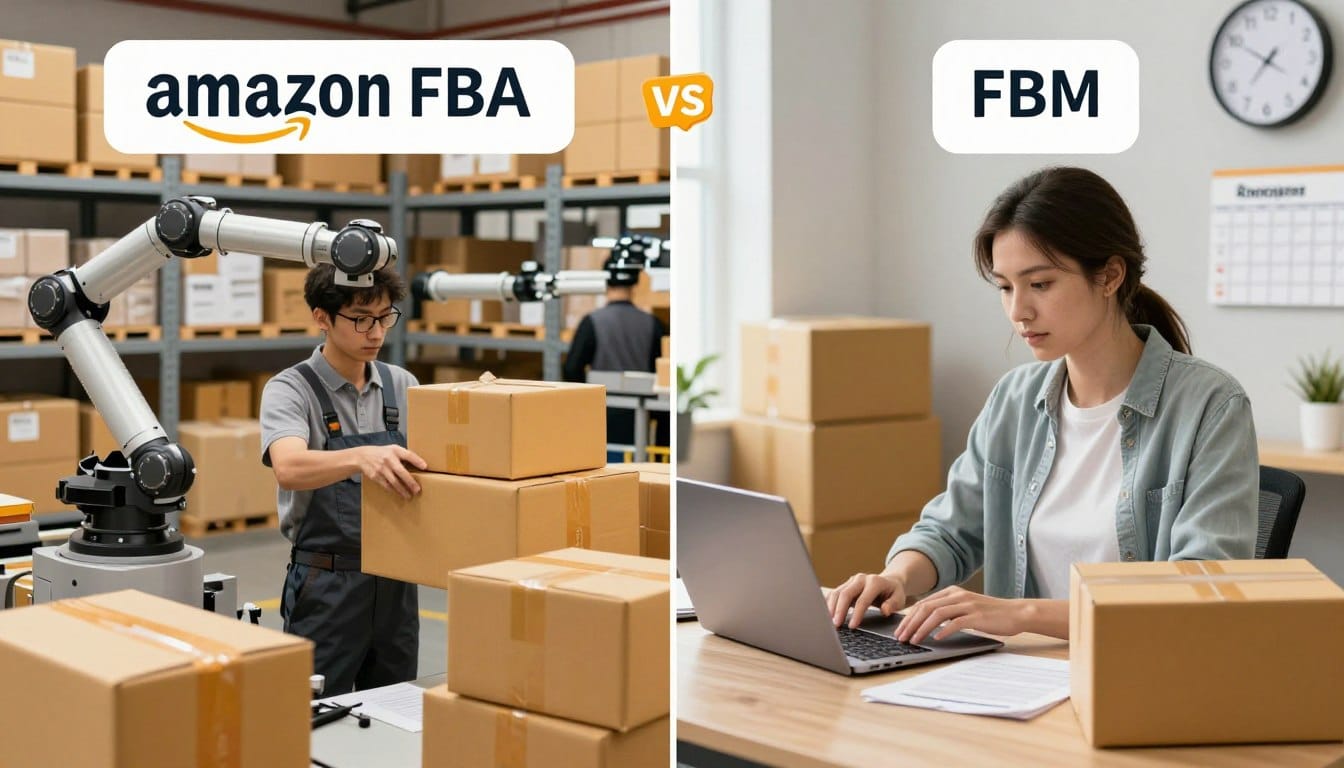
Comparing Fulfillment Methods: FBA vs FBM
Choosing the right fulfillment method can significantly impact your online business’s success. Two popular options are Fulfillment by Amazon (FBA) and Fulfillment by Merchant (FBM). Each method has its own advantages and challenges that can affect your operations and profitability.
How Fulfillment by Amazon (FBA) Works
Fulfillment by Amazon is a comprehensive service where Amazon stores your products in their warehouses. When an order is placed, Amazon picks, packs, and ships the items directly to customers. They also handle customer service and returns, effectively removing fulfillment as a bottleneck for sellers.
One of the critical advantages of using FBA is that your products become Prime eligible. This dramatically increases visibility and conversion rates since millions of shoppers filter specifically for Prime products. The Amazon algorithm also tends to favor FBA listings, enhancing their ranking.
Advantages and Disadvantages of Using FBA
While FBA offers many benefits, it’s essential to understand the costs involved. The complete FBA cost structure includes:
- Monthly storage fees based on cubic feet of space used.
- Per-unit fulfillment fees determined by product size and weight.
- Additional long-term storage fees for inventory held over 365 days.
Despite these costs, FBA often proves more economical than managing fulfillment yourself. This is especially true when you factor in your time, shipping supplies, and the sales boost from Prime eligibility.
However, there are disadvantages to consider. Handling and storage fees can accumulate quickly for slow-moving products. Strict product preparation guidelines must be followed to avoid extra charges. Additionally, stickerless commingling can lead to incorrect deliveries, and Prime returns may increase overall return rates.
When to Consider Fulfillment by Merchant (FBM)
Fulfillment by Merchant is an alternative where sellers manage all aspects of storage, shipping, and customer support. This method provides greater control over inventory and fulfillment operations but requires significant logistics experience and resources.
FBM makes strategic sense in specific scenarios:
- For large or heavy items where FBA fees would be prohibitive.
- For products with slow turnover that would incur high storage fees.
- For customized or made-to-order products that cannot be stored in advance.
- For sellers with efficient existing fulfillment operations who want to maintain complete control over the customer experience.
Hybrid Fulfillment Strategies
A hybrid approach can also be effective. Sellers can use FBA for fast-moving, standard-size products that benefit most from Prime eligibility while utilizing FBM for oversized items or slow-moving inventory. This strategy optimizes the cost structure across your entire product catalog.
In conclusion, the choice of fulfillment method shapes your entire business model, time investment, and scalability potential. Sellers should evaluate each product individually based on size, weight, sales velocity, and margin profile to determine the most profitable fulfillment approach.
Understanding Amazon Fees and Cost Management
Grasping the intricacies of Amazon’s fee structure is crucial for any seller’s financial health. Understanding these costs helps you price your products correctly and maintain profitability. If not managed well, fees can consume 30% to 50% of your sale price.
Referral Fees and Fulfillment Fees Explained
Referral fees are Amazon’s commission on each sale, ranging from 6% to 45% depending on the product category. Most categories fall around the 15% mark. For example, electronics typically incur an 8% fee, while accessories for Amazon devices can reach up to 45%. These fees are non-negotiable and apply whether you use Fulfillment by Amazon or manage fulfillment yourself.
Fulfillment fees apply only if you choose to use Amazon’s fulfillment services. These fees vary based on product size and weight. For instance, a small standard-size item under 12 ounces might cost approximately $3.22 to fulfill. In contrast, a large standard-size item weighing between 1 to 2 pounds could cost $5.00 or more.
Storage Fees and Long-Term Storage Considerations
Storage fees for items stored in Amazon’s warehouses are charged monthly and vary by season. From January to September, standard-size items cost about $0.87 per cubic foot. However, during the peak holiday season from October to December, this fee increases to $2.40 per cubic foot. Additionally, inventory stored for over 365 days incurs long-term storage fees, which can significantly impact your overall costs.
Hidden and Additional Amazon Fees
There are several hidden costs that can catch new sellers off guard. Returns processing fees apply when customers return items fulfilled by Amazon. Unplanned service fees are assessed if your shipments fail to meet Amazon’s preparation requirements. Furthermore, there are removal or disposal fees for unsold inventory and high-volume listing fees for sellers with over 100,000 active listings. Rental book service fees may also apply where relevant.
Calculating Product Profitability
To determine your product’s profitability, use this formula: Sale Price minus the sum of Referral Fee, Fulfillment Fee, Product Cost, Shipping to Amazon, and Advertising Cost equals Your Profit. It’s essential to ensure that this calculation leaves at least 20% to 30% of the sale price as profit. If it doesn’t, the product may not sustain a healthy business model.
Utilizing Amazon’s FBA fee calculator can help you determine exact costs based on specific product dimensions and weight. Small differences in packaging size or weight can significantly impact fulfillment fees and overall profitability.
Managing and reducing fees is an ongoing process. Strategies include optimizing product packaging to fit smaller size tiers, maintaining healthy inventory levels to avoid long-term storage fees, and planning inventory replenishment carefully to minimize peak-season storage costs.
In conclusion, effective fee management is crucial for sustaining and growing your online business. Regularly review Amazon’s fee schedule changes, monitor inventory performance metrics, and analyze product-level profitability to ensure your business remains sustainable.
How to Create an Optimized Amazon Listing That Gets Discovered

Creating an optimized product listing is crucial for attracting customers and boosting sales. A well-crafted listing not only enhances visibility in search results but also increases conversion rates once shoppers find your products. In 2025, sellers must consider both traditional search algorithms and emerging AI-powered discovery tools when optimizing their listings.
Keywords play a vital role in driving discoverability. Conduct thorough research to identify the terms customers use to find products similar to yours. Utilize Amazon’s search bar autocomplete, analyze competitor listings, and leverage keyword research tools. Your primary keywords should be placed in the product title, while secondary keywords can populate bullet points and the product description.
Keyword Research and Placement Strategies
Effective keyword research is the foundation of your listing’s success. By understanding customer search behavior, you can strategically position keywords where they matter most. Ensure that your primary keywords appear in the product title, as this is a key factor in search ranking.
Writing Effective Product Titles and Bullet Points
Product titles on Amazon typically follow specific formulas based on category. They should include the brand name, product type, key features, size or quantity, and sometimes color or material. For example: BrandName Stainless Steel Water Bottle – 32oz Insulated Leak-Proof Sports Bottle with Straw Lid – BPA Free. Titles can be up to 200 characters but should prioritize readability while naturally incorporating keywords.
Bullet points are equally important. Use all five bullet points Amazon provides to highlight key features and benefits. Focus on what customers care about, such as how the product solves their problem, dimensions, quality, and unique selling propositions that differentiate your product from competitors.
Importance of Quality Images and AEO
Quality images are critical for driving conversions. Your main image should feature a pure white background, clearly showing the entire product. Fill additional image slots with lifestyle images, infographics, size comparisons, and demonstration images to enhance customer understanding and expectations.
Professional photography is not optional for sellers who want to compete seriously. High-quality images significantly impact click-through rates and conversion rates on product detail pages.
Additionally, Answer Engine Optimization (AEO) is becoming increasingly important. AI tools like ChatGPT and Amazon’s Rufus help shoppers research and find products. Listings must clearly answer common customer questions within the product description and A+ Content.
To optimize product descriptions and A+ Content, provide comprehensive, factual information that addresses customer pain points and frequently asked questions in a natural, conversational tone. Backend search terms, which are hidden keywords that Amazon indexes, should also be populated with relevant terms that didn’t fit into the visible listing elements.
In conclusion, listing optimization is an ongoing process. Regular updates based on performance data, competitor analysis, and evolving search trends are essential. A well-optimized listing serves as the foundation for all advertising and promotional efforts that follow.
| Element | Importance |
|---|---|
| Keyword Research | Drives discoverability and search ranking |
| Product Title | Essential for visibility and readability |
| Bullet Points | Highlights key features and benefits |
| Quality Images | Increases conversion rates |
| Answer Engine Optimization | Enhances product discovery through AI tools |
Managing Inventory and Performance Metrics
Effective inventory management is vital for the success of any online business. It helps sellers maintain control over their products and optimize their operations. One key tool in this process is the Inventory Performance Index (IPI), which provides valuable insights into your inventory levels within fulfillment centers.
Using the Inventory Performance Index
The Inventory Performance Index (IPI) is Amazon’s proprietary metric that gives sellers a comprehensive overview of their inventory health. It measures factors such as excess inventory levels, sell-through rates, stranded inventory percentages, and in-stock rates for popular products. By actively using the IPI score, sellers can make timely inventory replenishment decisions.
Identifying products that have been stored in Amazon’s centers for extended periods is crucial. Taking proactive measures can help avoid costly long-term storage fees that apply to inventory aged over 365 days. Maintaining a healthy IPI score is essential, as Amazon uses this metric to determine storage limits. Poor scores may restrict inventory shipments, so monitoring the index regularly through Seller Central is necessary.
Strategies for Inventory Replenishment and Avoiding Storage Fees
Effective strategies for inventory replenishment include setting up automated reorder points based on sales velocity and lead times. Utilizing Amazon’s restock recommendations while applying independent analysis can help maintain buffer stock levels. This accounts for supplier variability and unexpected demand spikes without creating excess inventory.
It is critical to follow all Amazon packaging and preparation guidelines when sending products to fulfillment centers. Non-compliance can result in unplanned service fees, shipment refusals, or returned inventory, disrupting the supply chain and incurring additional costs.
Managing seasonal inventory presents unique challenges. Sellers must order products months in advance of peak seasons. Demand forecasting errors can be punishing: ordering too little results in stockouts and lost sales, while ordering too much leads to excess inventory and elevated storage fees during peak periods.
To reduce return rates, ensure product descriptions are detailed and accurate. This prevents customer misunderstandings and encourages satisfaction. Regularly monitoring and answering customer questions on product detail pages can also help mitigate returns. Additionally, using return reason data can identify and address recurring product quality or listing accuracy issues.
Utilizing Amazon’s inventory reports and third-party inventory management tools is essential for tracking product-level performance. These tools help identify slow-moving items before they incur long-term storage fees. Data-driven decisions about removal orders, liquidation, or promotional pricing can clear aging inventory effectively.
Maintaining adequate stock levels is vital to avoid stockouts. Stockouts not only result in lost sales but also negatively impact organic search rankings. A listing can lose hard-earned momentum, making it difficult and expensive to rebuild through advertising.
In conclusion, effective inventory management is a balancing act. Sellers must maintain sufficient stock to capture sales while avoiding excessive storage fees. This requires ongoing attention, data analysis, and a willingness to make tough decisions about underperforming inventory before storage costs erode profitability.
| Metric | Description |
|---|---|
| Excess Inventory | Products that are overstocked and may incur long-term storage fees. |
| Sell-Through Rate | The percentage of inventory sold over a specific period. |
| Stranded Inventory | Inventory that is not available for sale due to listing issues. |
| In-Stock Rate | The percentage of time products are available for purchase. |
Leveraging Advertising and PPC for Growth
In the competitive landscape of online retail, leveraging advertising can significantly elevate your sales potential. Even for products shipped with Fulfillment by Amazon, ads are essential to stand out from the competition. With millions of listings available, strategic advertising ensures that potential customers discover your products.
Overview of Advertising Options
Amazon offers multiple advertising options to help sellers promote their products effectively. These include:
- Sponsored Products: Ads that promote individual listings in search results and product detail pages.
- Sponsored Brands: Ads that showcase a brand’s product portfolio with custom headlines and logos.
- Sponsored Display: Ads that retarget shoppers based on their browsing behavior and interests.
Essential Advertising Strategies for Visibility
Starting with automatic campaigns is a smart strategy. This approach allows you to gather valuable keyword data and insights into customer search behavior. Once you have this data, transition to manual campaigns where you can bid on specific high-performing keywords. This gives you greater control over your budgets and placements.
Utilizing advertising data strategically is key. Identify high-converting search terms and negative keywords that waste your spend. Continuously refine your campaigns by adjusting bids and reallocating budgets toward top-performing targets.
Balancing Advertising Costs with Profitability
Advertising costs have risen significantly as the platform has matured. It’s crucial for sellers to balance their advertising spend with profitability. Calculate the break-even Advertising Cost of Sale (ACoS) based on your product margins. This will help you determine how much you can afford to spend on ads while still maintaining a profit.
For initial advertising budgets, most sellers should start with a minimum of $5 to $10 per day. This budget allows for enough data generation for meaningful optimization. However, the appropriate budget will depend on your product’s price point, category competition level, and target profit margins.
Understanding key advertising metrics is also essential. Metrics like ACoS, click-through rate, and conversion rate provide insights into your advertising efficiency. Additionally, total advertising cost of sale (TACoS) measures your advertising spend as a percentage of total revenue, offering a complete picture of your advertising performance.
Consider using advertising automation tools like BidX. These tools can save you valuable time through automated bid adjustments and keyword management. This allows you to focus on other core aspects of your business while maintaining efficient advertising campaigns.
Throughout a product’s lifecycle, advertising plays a strategic role. From aggressive launch-phase spending to generate initial sales velocity and reviews, to maintenance-phase spending that defends your market position, advertising is crucial. Even during liquidation phases, targeted ads can help clear aging inventory before storage fees accumulate.
In conclusion, successful advertising requires a data-driven approach. Continuous testing and optimization, along with a clear understanding of the relationship between advertising spend, sales volume, and overall profitability, are vital. Ultimately, the goal is to build sustainable organic rankings that reduce long-term dependence on paid advertising.
International Selling and Cross-Border Logistics
Expanding your business internationally can open doors to new markets and opportunities. Utilizing effective fulfillment methods is crucial for sellers looking to reach customers across borders. When leveraging FBA for international orders, it’s important to understand the differences between European and non-European marketplaces.
For non-European markets, sellers must import products into the destination country. This involves navigating customs clearance and complying with all import regulations before inventory can be stored in local fulfillment centers. Ensuring adherence to these laws is essential for a smooth operation.
Using Amazon FBA for Cross-Border Fulfillment
Amazon offers three international fulfillment programs for European marketplaces:
- Pan-European FBA: Sellers ship to one domestic fulfillment center, and Amazon distributes inventory across all European marketplaces based on demand.
- European Fulfillment Network: Products are stored in one center and shipped cross-border when international orders occur.
- Multi-Country Inventory: Sellers send products directly to the countries with the highest demand for faster delivery.
Regulatory Compliance and Tax Considerations
When selling internationally, regulatory compliance is critical. Sellers must adhere to country-specific product safety standards and labeling requirements in local languages. Tax obligations, such as VAT registration in European marketplaces and sales tax collection in the US, must also be considered.
For international sellers, filing a W-8BEN form is necessary to declare foreign entity status. This form establishes that the seller is not subject to US income tax withholding on sales. Given the complexity of tax laws, consulting with a tax professional familiar with international e-commerce is highly advisable.
Payment Methods for International Sellers
International sellers on Amazon USA have three payment options:
- Open a US bank account through international banks or fintech services.
- Use Amazon’s built-in currency converter to receive payments in the seller’s home country currency where available.
- Utilize third-party payment providers like Payoneer, Wise, or WorldFirst that create virtual US bank accounts for receiving Amazon disbursements.
Additionally, it’s important to factor in currency conversion fees and exchange rate fluctuations when setting prices in foreign marketplaces. These costs can significantly impact profit margins if not properly accounted for.
Lastly, ensure that you meet compliance requirements for product safety regulations in target markets. Items like electronics and food products face stringent requirements, so sellers must verify that suppliers provide necessary certifications before shipping inventory internationally.
In conclusion, international expansion through effective fulfillment methods offers significant growth opportunities. However, careful planning around compliance, taxes, payments, and logistics is essential. Mastering your domestic marketplace before expanding internationally will help avoid overextending resources and operational capacity.
| Fulfillment Program | Description |
|---|---|
| Pan-European FBA | Distributes inventory across all European marketplaces based on demand. |
| European Fulfillment Network | Stores products in one center and ships cross-border for international orders. |
| Multi-Country Inventory | Sends products directly to countries with the highest demand for faster delivery. |
Additional Tips for Optimizing Your Amazon FBA Business

To thrive in the competitive world of online selling, sellers must continually refine their strategies and practices. Achieving success with the fulfillment program requires a comprehensive understanding of the rules and guidelines set forth by the platform. Compliance is non-negotiable; violations can lead to account suspension or listing removal.
Following Amazon’s Rules and Guidelines
Adhering to all of Amazon’s rules, guidelines, and terms of service is crucial for sustainable use of the fulfillment program. Sellers should ensure that products are packaged according to Amazon’s standards before sending them to fulfillment centers. This includes:
- Proper labeling of products.
- Poly-bagging requirements for certain items.
- Box weight and dimension limits.
Failure to comply can result in unplanned service fees and shipment refusals, disrupting operations.
Utilizing Tools for Inventory and Ad Management
Maximizing efficiency requires utilizing a full range of available tools for inventory management and advertising optimization. Sellers should leverage:
- Amazon’s Seller Central reports to track the Inventory Performance Index and sales data.
- Third-party product research tools like Helium 10 and Jungle Scout for ongoing market analysis.
- Advertising automation tools like BidX that save valuable time through automated bid and keyword adjustments.
Mitigating Returns and Customer Service Challenges
Returns can increase when products have Prime status due to the ease of the return process. To mitigate returns, sellers should invest in:
- Extremely detailed and accurate product descriptions.
- High-quality images that set accurate expectations.
- Proactive customer question answering on product detail pages.
These practices help eliminate misunderstandings before purchase and enhance customer satisfaction.
For small and low-cost products, sellers should consider Amazon’s Small and Light program. This program offers reduced fulfillment fees compared to standard rates, encouraging sellers to minimize packaging to the essentials. Maintaining excellent customer service standards is also vital, even when the platform handles customer interactions. Regularly monitoring product reviews and responding promptly to any issues can lead to improved product quality and listing accuracy.
Building a strong brand presence is essential. Consistent product quality, professional packaging, and a cohesive brand story across all listings create durable competitive advantages. Additionally, sellers should regularly review Amazon’s fee schedule and policy updates to adapt their strategies proactively.
Finally, continuously monitoring and optimizing advertising campaigns is crucial. Even well-established products benefit from strategic PPC management to maintain visibility and identify new keyword opportunities as market trends evolve.
In conclusion, optimizing an FBA business is an ongoing process that requires attention to compliance, inventory management, customer experience, and advertising efficiency. Sellers who invest in the right tools and develop systematic processes for each area position themselves for sustainable long-term profitability.
| Tip | Description |
|---|---|
| Follow Guidelines | Ensure compliance with all packaging and labeling requirements to avoid fees. |
| Utilize Tools | Leverage Seller Central and third-party tools for effective inventory and ad management. |
| Mitigate Returns | Invest in quality descriptions and images to reduce return rates. |
| Build Brand | Create a strong brand presence through consistent quality and messaging. |
| Monitor Advertising | Continuously optimize PPC campaigns for sustained visibility. |
Conclusion
Envision a future where your online venture has blossomed into a successful business, transforming your dreams into reality. The journey through this comprehensive resource highlights that success in eCommerce requires a structured approach. This includes proper account setup, thorough product research, and smart fulfillment choices.
Understanding the fee structure is vital for maintaining profitability. Sellers who grasp these elements can effectively manage their inventory and optimize their listings for better visibility. Moreover, viewing your online business as a long-term brand-building opportunity is essential.
As you embark on this journey, remember that patience and adaptability are key. Start by choosing your seller account type and prepare your documentation. With the right strategies, the potential for growth is immense. Following Amazon’s rules ensures your hard work leads to lasting success.
In conclusion, the marketplace will continue to evolve, but the principles of good product selection and customer focus will remain the foundation of profitable selling for years to come.


 By
By













I like how this guide emphasizes understanding the current marketplace dynamics instead of just jumping into selling. One thing I’ve noticed is that many new sellers underestimate how important product research and differentiation are in such a saturated space. It would be interesting to hear your take on how beginners can validate demand before committing to inventory.
Thank you for the fantastic feedback! You’ve raised a crucial point—product research and differentiation are absolute game-changers in today’s Amazon landscape.
To answer your question about validating demand without risking capital on inventory, we always recommend beginners start with a data-driven approach. Tools like Jungle Scout or Helium 10 are vital to analyze historical sales volume and search trends. Additionally, checking the ‘Best Sellers Rank’ (BSR) of competitors, analyzing the consistency of their reviews, and even running a small, low-budget test with PPC can provide great insights before making a bulk order
.
Stay tuned, as we plan to cover demand validation frameworks in depth in our upcoming articles!
What a fantastic blog! It contains valuable information. This is the first time I’ve seen such a professional blog.
Thank you so much