


Welcome to your journey into the world of blockchain! This innovative system is transforming how Americans manage their finances, from saving to investing and everyday transactions. Here, we will break down complex concepts into simple, relatable terms, making it easy for you to understand why this matters.
Imagine a secure digital ledger that records every transaction without the need for a central authority. This decentralized network ensures that your data is safe and tamper-proof. With a projected growth of nearly $1 trillion by 2032, understanding this system can empower you financially.
In this guide, we’ll walk you through the essential components—from how transactions are grouped into blocks to the cryptographic chains that keep information secure. By the end, you’ll feel confident navigating this exciting landscape, equipped with the knowledge to make informed financial decisions.
Key Takeaways
- Unlock the mystery behind blockchain and its impact on your finances.
- Learn how this system serves as a secure digital record-keeper.
- Discover why major companies are investing heavily in this space.
- Understand the core components that make this technology work.
- Gain insights into how this could affect your financial future.
Understanding the User Intent Behind Blockchain Technology Explained for Beginners
Let’s dive deeper into what drives interest in this innovative system. Many people are curious about how this framework impacts their lives, especially in finance and technology. Whether you’re interested in investing in cryptocurrency or exploring a career in FinTech, your questions are valid.
Perhaps you’ve heard the term “blockchain” in discussions about Bitcoin, digital payments, or supply chain tracking. You want to know what all the fuss is about without wading through dense technical manuals. This guide aims to provide you with a clear understanding of how this system can fit into your financial toolkit.
As an everyday American, you might be looking to make smarter money decisions. You could be wondering if this system has a place in your financial strategy. Or maybe you’re a professional seeking to stay relevant in a job market where blockchain skills are increasingly in demand across various industries like finance, healthcare, and logistics.
Whatever brought you here, your core intent is the same: you want a trustworthy, straightforward explanation that connects the workings of this system to tangible benefits you can actually use. We’ll help you understand not just what blockchain is, but why it matters to your daily life—from faster, cheaper money transfers to more secure ways of proving your identity online.
By recognizing your intent upfront, we can tailor every subsequent section to answer the questions you’re actually asking. This approach ensures you receive the insights you need, without assuming prior knowledge of complex jargon.
| User Intent | Motivation | Outcome |
|---|---|---|
| Curiosity about blockchain | Understand its relevance in finance | Informed investment decisions |
| Interest in career opportunities | Stay relevant in a changing job market | Enhanced job prospects |
| Desire for knowledge | Join conversations confidently | Increased engagement in discussions |
What is Blockchain? Core Concepts and Terminology Every Beginner Should Know
Envision a shared ledger that everyone trusts but no one controls. This is the essence of a blockchain—a digital record that captures every transaction in a secure and transparent manner. It operates across a peer-to-peer network, eliminating the need for intermediaries like banks.
At its core, a blockchain is an immutable ledger. Each transaction is recorded in a block, which is then linked to the previous block, forming a chain. This structure ensures that once data is added, it cannot be altered without the consensus of the entire network.
Let’s break down some essential terms:
- Distributed Ledger: Think of this as a shared digital record book that no single entity controls—similar to a Google Doc that everyone can view but no one can secretly edit.
- Nodes: These are the computers that make up the network, validating and storing the transactions.
- Hashing: Each block contains a unique cryptographic fingerprint called a hash, which links it securely to the previous block.
- Decentralization: Instead of relying on one bank’s database, the network distributes identical copies of the ledger across thousands of computers worldwide.
Understanding these concepts is crucial. Once data is recorded on the blockchain, altering it would require changing every subsequent block across the entire network—a practically impossible task. This feature ensures trust and transparency in transactions.
Moreover, the idea of peer-to-peer transactions allows you to send value directly to another person without any intermediaries taking a cut. This can revolutionize how we think about cryptocurrency and financial interactions.
By the end of this section, you will have a solid grasp of what a blockchain is and the confidence to discuss it with others. The more you understand, the better equipped you will be to navigate this exciting landscape.
How Does Blockchain Technology Work?
Let’s uncover the mechanics behind this groundbreaking system. Understanding how this digital ledger operates is essential for grasping its significance. Here, we will walk through the process of a transaction, highlighting the role of blocks, the distributed ledger, and the consensus mechanisms that keep everything in sync.
Structure and Role of Blocks and Transactions
Every transaction is recorded as a “block” of data on the network. These blocks capture vital details about asset movement, whether tangible or intangible. Inside each block, you’ll find:
- Sender and Receiver: Who is involved in the transaction.
- Transaction Amount: The value being transferred.
- Timestamp: The exact moment the transaction is recorded.
- Unique Hash: A digital fingerprint that links the block to the previous one.
Each new block carries the hash of the block before it, creating an unbreakable chain. Tampering with one block will immediately reveal the damage in every subsequent block.
Distributed Ledger Technology Explained
The concept of a distributed ledger is powerful. Thousands of identical copies exist simultaneously across nodes around the world. This setup eliminates any single point of failure or control. When you initiate a transaction, nodes—computers running blockchain software—constantly communicate to verify its validity.
This decentralized nature ensures that your data is secure and that the network remains resilient against attacks. The more nodes that participate, the stronger the network becomes.
Consensus Mechanisms: How the Network Agrees
Consensus mechanisms are the democratic heart of this system. They determine how transactions are validated and added to the blockchain. Two common methods are:
- Proof of Work (PoW): Miners solve complex puzzles to validate transactions.
- Proof of Stake (PoS): Validators put up their own cryptocurrency as collateral to confirm transactions.
PoS is gaining traction as a faster, more energy-efficient alternative while maintaining robust security. By understanding these mechanisms, you can appreciate how the network achieves consensus and keeps your transactions safe.
By following a transaction’s journey from initiation to its permanent home on the blockchain, you’ll gain confidence in this innovative system. You’ll never again wonder whether your digital payment went through or if your data is truly secure.
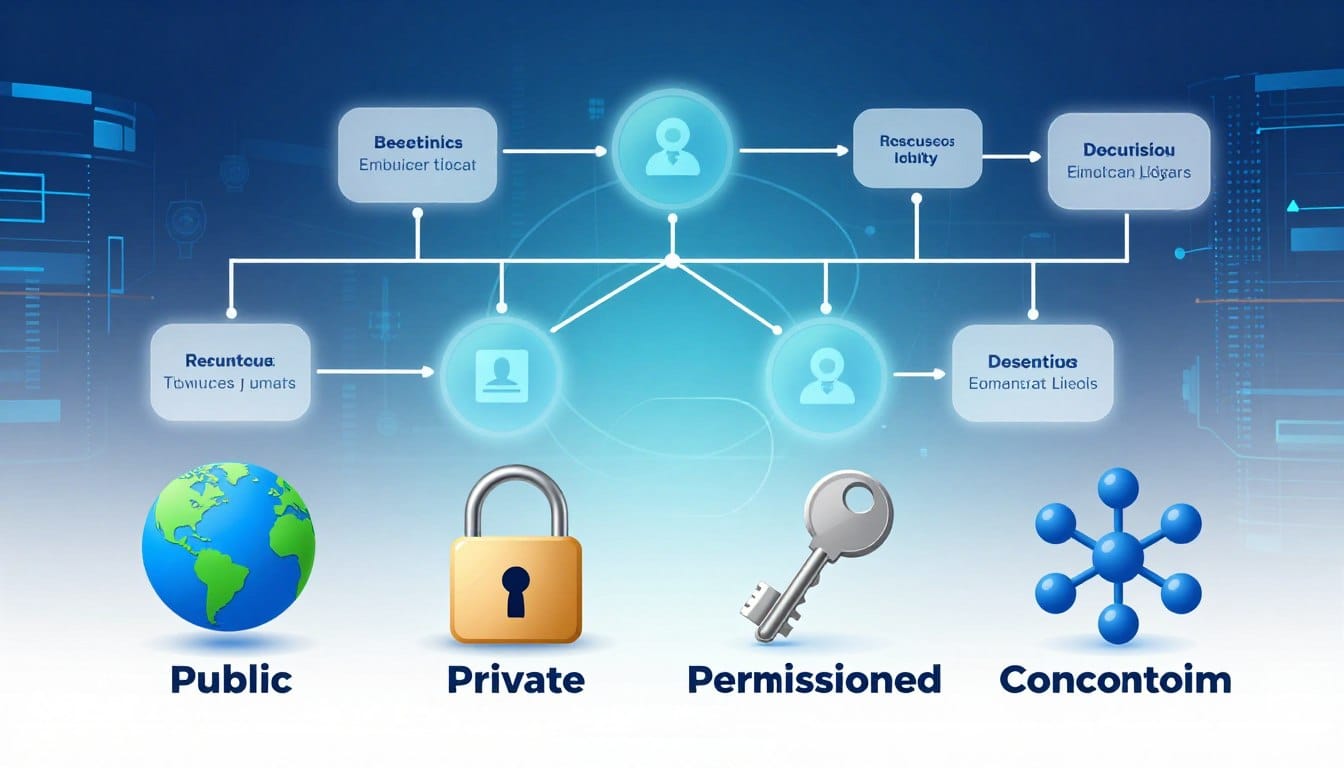
Types of Blockchain Networks: Public, Private, Permissioned, and Consortium
Understanding the different types of blockchain networks can significantly impact how you interact with this digital landscape. Each type serves distinct purposes and offers unique advantages.
Let’s explore these four main types of networks, which include public, private, permissioned, and consortium blockchains. Each serves different needs and scenarios.
Public Blockchains and Their Open Access
Public blockchains are like the digital Wild West. Anyone with an internet connection can join, view transactions, and help secure the network without asking permission. Notable examples include Bitcoin and Ethereum.
These networks prioritize radical transparency and decentralization. This makes them ideal for cryptocurrencies, where trust in a central authority is exactly what you want to avoid. As a user, you can engage freely, knowing that the system operates on shared consensus.
Private Blockchains for Controlled Environments
In contrast, private blockchains flip the script. Here, a single organization governs the network, controlling who can participate. Companies like IBM and Walmart use these networks for internal supply chain tracking or sensitive financial data.
This controlled access enhances privacy and security, making it suitable for businesses that need to protect proprietary information. Only authorized users can access the data, ensuring that sensitive information remains confidential.
Permissioned and Consortium Blockchains for Shared Governance
Permissioned networks add a layer of role-based access. Even within a private system, you can control who can view data versus who can add new transactions. Think of it as a VIP list with different access levels.
Consortium blockchains take this a step further. A group of preselected organizations actively manages these networks, sharing governance responsibilities. This model is particularly popular in sectors like banking and logistics.
For example, energy producers and consumers might use a consortium blockchain to share power usage data without exposing competitive secrets. This collaborative approach enhances trust and efficiency among the involved parties.
By the end of this section, you’ll be able to identify which type of blockchain network suits various scenarios. Understanding these distinctions is crucial for recognizing how they impact security, privacy, and efficiency in your interactions.
A Brief History and Evolution of Blockchain Technology

Let’s take a step back in time to uncover the fascinating origins of this revolutionary system. The journey begins in 1991 when Stuart Haber and W. Scott Stornetta envisioned a cryptographically secured chain of blocks to timestamp documents. This idea laid the groundwork long before Bitcoin became a household name.
The story truly ignites in 2008 when the mysterious Satoshi Nakamoto published the Bitcoin whitepaper. This document proposed a peer-to-peer digital currency that could operate without banks or governments, especially in the wake of the global financial crisis. It was a bold idea that challenged traditional financial systems.
In 2009, the first Bitcoin transaction proved that decentralized digital currency was not just theory; it was a working system. This moment marked the beginning of a global movement toward financial independence.
Fast forward to 2015, when Ethereum launched. This platform introduced smart contracts, transforming the landscape from a simple payment network into a programmable platform for decentralized applications. This shift opened up a world of possibilities for various applications beyond currency.
As we trace the evolution of this technology, companies like IBM and Home Depot began adopting it for supply chain and vendor management. This shift signaled a growing recognition of the technology’s potential in enterprise settings.
Recent U.S. policy shifts, including the July 2025 GENIUS Act signed by President Trump, have brought regulatory clarity to stablecoins. This act marked a significant step in legitimizing cryptocurrencies and integrating them into the mainstream financial system.
Today, blockchain underpins everything from NFT marketplaces to government data publishing. The Department of Commerce is now releasing economic data on public blockchains, showcasing the technology’s versatility.
Understanding this history helps you see blockchain not as a passing fad but as a technology that’s been building momentum for over three decades. And guess what? You’re still early to the party!
| Year | Milestone | Significance |
|---|---|---|
| 1991 | First cryptographic chain | Foundation for secure digital records |
| 2008 | Bitcoin whitepaper published | Introduction of decentralized digital currency |
| 2009 | First Bitcoin transaction | Proved the concept of digital currency |
| 2015 | Launch of Ethereum | Introduction of smart contracts |
| 2025 | GENIUS Act signed | Regulatory clarity for cryptocurrencies |
Key Features and Components of Blockchain

Let’s explore the essential features that make this system stand out in the digital world. Understanding these components will give you a clearer picture of how this framework operates and why it matters.
Immutable Records: Ensuring Data Integrity
One of the most powerful aspects of this system is its immutability. Once a transaction is recorded in the shared ledger, it cannot be altered or deleted. This creates an unbreakable audit trail that enhances trust.
If an error occurs, a new transaction must be added to correct it. Both the original mistake and the correction remain visible, ensuring total transparency. This is why immutability is often considered the superpower of this system.
Smart Contracts: Automating Trust
Smart contracts are another revolutionary feature. Think of them like a vending machine. You insert money and make a selection, and the machine automatically delivers your snack—no human needed.
These self-executing agreements are coded directly into the system. They automatically fulfill their terms when predefined conditions are met. This automation is transforming industries, streamlining processes like insurance payouts and royalty payments.
Cryptography and Hashing: The Backbone of Security
Security is paramount, and cryptography plays a vital role. Public key cryptography secures transactions and data on the network. You have a public key, like an email address, which you can share, and a private key, akin to a password, that you must keep secret.
Hashing is another critical element. It’s a one-way mathematical function that converts any piece of data into a unique string of characters. Even a minor change in the original data will result in a completely different hash. This ensures that the integrity of the data is maintained.
These cryptographic elements work together to create a system where trust is placed not in individuals or institutions but in mathematics itself. By mastering these core components, you will have the foundation to evaluate any project and understand what makes it secure, transparent, and efficient.
| Feature | Description | Significance |
|---|---|---|
| Immutable Records | Transactions cannot be altered after recording. | Ensures data integrity and transparency. |
| Smart Contracts | Self-executing agreements coded in the system. | Automates processes, reducing the need for intermediaries. |
| Cryptography | Uses public/private keys to secure data. | Protects user assets and transaction information. |
| Hashing | Transforms data into unique strings. | Maintains data integrity and prevents tampering. |
Benefits of Blockchain Technology Explained for Beginners Should Know
Discover how this advanced system can significantly improve various aspects of your financial dealings. The benefits are tangible and can make a real difference in your everyday life.
Enhanced Security: One of the most compelling advantages is the enhanced security it offers. Each transaction requires consensus among network members, making it nearly impossible for unauthorized changes. Once a transaction is recorded, no administrator, hacker, or government can alter or delete it.
Greater Trust: This system eliminates the need to rely on a single bank, broker, or intermediary. All participants can see the same immutable record, which fosters a higher level of trust among users.
Increased Efficiency: You’ve likely experienced the frustration of waiting days for a bank transfer to clear. With this system, transactions can settle in minutes, 24/7, without the delays of traditional banking hours.
Better Traceability: Imagine scanning a QR code on your food and seeing its entire journey from farm to store shelf. This system provides instant traceability, verifying that the “organic” label is genuine, not just marketing.
Automated Transactions: Smart contracts automate transactions seamlessly. For example, you could receive an instant insurance payout when your flight is delayed, without filing a claim or waiting weeks for a human adjuster.
Companies leveraging this system for supply chain management are cutting costs and reducing fraud. These savings ultimately trickle down to you as a consumer through better prices and more authentic products.
Moreover, the transparency this system offers creates end-to-end visibility. It holds corporations accountable, whether it’s verifying ethical sourcing of diamonds or ensuring fair trade coffee truly is fair trade.
These benefits are not just abstract promises; they represent practical improvements to the financial and commercial systems you interact with every single day.
| Benefit | Description | Real-World Example |
|---|---|---|
| Enhanced Security | Transactions require network consensus, making them immutable. | No alterations by hackers or administrators. |
| Greater Trust | Eliminates reliance on single intermediaries. | All users see the same records. |
| Increased Efficiency | Transactions settle in minutes, not days. | 24/7 availability without delays. |
| Better Traceability | Instant verification of product origins. | Scanning QR codes for food authenticity. |
| Automated Transactions | Smart contracts execute automatically. | Instant payouts for flight delays. |
Common Challenges and Limitations Facing Blockchain Today
In this section, we will confront the real-world limitations of this technology. Understanding these challenges is essential for anyone looking to engage with this evolving system.
First, scalability remains a significant hurdle. When too many users access a blockchain network simultaneously, transactions can slow down and fees may spike. This is often why you hear about congestion during peak trading days, particularly with cryptocurrencies like Bitcoin.
Energy consumption is another critical concern. The computational power required for processes like Bitcoin’s proof-of-work consensus mechanism uses vast amounts of electricity. However, newer consensus methods, such as Proof of Stake, are emerging and reducing energy use by over 99%.
Regulatory uncertainty is still a hot topic in the United States. Governments are working to update laws that address decentralization. Recent legislation, like the GENIUS Act, shows that clearer rules are on the horizon, but many questions remain.
The learning curve can also be steep for newcomers. Managing private keys, understanding wallet addresses, and navigating exchanges can feel overwhelming without proper guidance. This complexity can deter potential users from fully engaging with the system.
Privacy on public networks is a double-edged sword. While transactions are transparent and traceable, which enhances accountability, it raises concerns for those who prefer their financial history to remain private.
Fortunately, innovative solutions are already in development. Layer 2 networks process transactions off the main chain, reducing congestion. Sharding divides databases into manageable pieces, and zero-knowledge proofs enable privacy without sacrificing security.
By understanding these challenges, you become a more informed participant in the blockchain space. This knowledge allows you to separate hype from reality and identify projects genuinely solving these problems.
| Challenge | Description | Potential Solutions |
|---|---|---|
| Scalability | Network congestion during high usage leads to slow transactions and increased fees. | Layer 2 solutions and sharding. |
| Energy Consumption | High electricity use in proof-of-work systems. | Transition to proof-of-stake mechanisms. |
| Regulatory Uncertainty | Laws are still evolving to address decentralization. | Legislation like the GENIUS Act is emerging. |
| Learning Curve | New users may struggle with managing wallets and private keys. | Educational resources and user-friendly platforms. |
| Privacy Concerns | Transparency can expose financial histories. | Zero-knowledge proofs for enhanced privacy. |
Popular Use Cases and Practical Applications of Blockchain Technology
Explore the practical applications of this digital ledger that are shaping industries around the globe. This system is not just a theoretical concept; it is actively transforming various sectors, making processes more efficient and secure.
Cryptocurrency and Digital Currency Management
One of the most famous applications of this system is in the realm of cryptocurrency. Bitcoin, the first decentralized digital currency, allows you to send money directly to anyone in the world without the need for banks. Transactions settle in minutes rather than days, making it a fast and efficient way to transfer value.
Supply Chain Transparency and Accountability
The supply chain revolution is already here. Companies like Home Depot are using IBM Blockchain to resolve vendor disputes more quickly. Nestle Oceania leverages Amazon Managed Blockchain to enhance transparency in their supply chain, allowing consumers to trace their food from farm to fork.
This radical transparency ensures that products labeled as “sustainably sourced” or “ethically made” live up to their marketing claims. It builds trust with consumers and improves accountability among suppliers.
Healthcare Record Security and Government Solutions
In healthcare, this system is addressing the challenges of fragmented medical records. By creating secure, interoperable systems, patients can control who accesses their health data and when. This enhances privacy and security, ensuring that sensitive information is protected.
Government applications are also moving from theory to reality. In August 2025, the U.S. Department of Commerce began publishing gross domestic product and personal consumption expenditure data on public blockchains. This makes official statistics tamper-proof and instantly verifiable.
Additionally, blockchain voting systems have been tested in West Virginia, aiming to eliminate election fraud concerns by creating an immutable, transparent record of every ballot cast.
The food industry is being transformed as companies attach IoT sensors and QR codes to products. This creates digital twins on the blockchain that track temperature, origin, and handling throughout the supply chain. This ensures food safety and quality for consumers.
Finally, banks are adopting this system for faster cross-border payments and more secure loan processing. This technology is not replacing traditional finance; it is upgrading it, proving its versatility and importance in today’s economy.
| Application | Description | Example |
|---|---|---|
| Cryptocurrency | Peer-to-peer digital currency management without banks. | Bitcoin enables fast transactions globally. |
| Supply Chain | Enhances transparency and accountability in product sourcing. | Home Depot uses IBM Blockchain for vendor disputes. |
| Healthcare | Secures medical records and patient data access. | Healthcare providers use blockchain for data privacy. |
| Government | Publishes economic data securely and transparently. | Department of Commerce uses public blockchains. |
| Voting | Creates an immutable record of votes cast. | West Virginia trials blockchain voting systems. |
Best Practices for Blockchain Security and Risk Mitigation
As you navigate the world of digital assets, understanding security is paramount. Whether you’re investing in cryptocurrency or exploring enterprise applications, implementing robust security measures is essential.
Here are some actionable steps to enhance your security:
- Private Key Management: Your private key is everything. Losing it means losing access to your assets forever. Always store it securely, preferably offline.
- Smart Contract Auditing: Don’t trust just any contract. Ensure that smart contracts have been independently reviewed to avoid vulnerabilities that could lead to significant losses.
- Regulatory Compliance: Adhere to industry regulations like GDPR. Implement privacy-enhancing technologies, such as zero-knowledge proofs, to protect sensitive information.
- Secure Messaging Protocols: Use encrypted messaging to ensure that your communications remain confidential, even if intercepted.
- Continuous Monitoring: Regularly monitor your systems for unusual activity. A well-defined incident response plan is vital for minimizing damage in case of a breach.
- Identity and Access Management: In permissioned networks, restrict access to sensitive data. Ensure only authorized users can view or manipulate critical information.
- Aligning with Financial Regulations: For businesses, it’s crucial to align your blockchain deployments with U.S. financial regulations and international standards to avoid compliance pitfalls.
These best practices transform blockchain from a theoretically secure framework into a practically secure system. By prioritizing security, you can trust this innovative system with your money, data, and business operations.
| Security Measure | Description | Importance |
|---|---|---|
| Private Key Management | Securely store your private key offline. | Prevents unauthorized access to your assets. |
| Smart Contract Auditing | Only use independently reviewed contracts. | Avoids vulnerabilities that can lead to hacks. |
| Regulatory Compliance | Follow GDPR and financial regulations. | Ensures legal protection and privacy. |
| Secure Messaging Protocols | Utilize encrypted communication channels. | Protects confidential information from interception. |
| Continuous Monitoring | Regularly check for unusual activities. | Enables quick response to potential breaches. |
| Identity and Access Management | Restrict data access to authorized users. | Protects sensitive information from unauthorized access. |
| Financial Regulation Alignment | Ensure compliance with U.S. and international standards. | Avoids costly compliance issues. |
Conclusion: Unlocking the Potential of Blockchain Technology Explained for Beginners
Having navigated this complex landscape, you stand equipped with knowledge that empowers your financial decisions. You’ve traveled from wondering about the basics to understanding how a decentralized ledger records transactions in immutable blocks linked by cryptographic hashes.
This journey has provided insights into public and private networks, smart contracts, and real-world applications that are reshaping industries. Remember, this system is not just about cryptocurrency; it’s a foundational technology that enhances trust in digital systems.
With the industry projected to grow to nearly one trillion dollars by 2032, your newfound knowledge positions you ahead of the curve. Explore small investments, research projects in your field, or dive deeper into areas like DeFi or NFTs.
The story of this system is still unfolding. By grasping its foundations today, you’re ready to evaluate tomorrow’s innovations with clarity and confidence. The world of decentralized networks is vast, and your journey is just beginning.


 By
By















I like how this article breaks down blockchain into practical concepts instead of relying on technical jargon. The point about decentralization and secure record-keeping is especially important because many beginners only associate blockchain with cryptocurrency, even though the technology has much broader applications in finance and data security.
Thank you for this fantastic feedback! You’ve highlighted a very common misconception. Shifting the perspective from ‘just cryptocurrency’ to the broader foundational power of decentralization and secure record-keeping is exactly what we aimed to achieve with this guide. Highlighting its practical applications in finance and data security is key to understanding where the future of tech is heading. We really appreciate you sharing this insightful value with our community!