


In today’s fast-paced work environment, selecting the right project management tools is crucial. With numerous options available, it can be overwhelming for teams to choose a platform that meets their specific workflow needs and business goals. This article aims to simplify that process.
We draw on years of hands-on experience with various project management solutions, from simple task trackers to comprehensive portfolio platforms. Our guide highlights ten noteworthy options, including monday work management, ClickUp, Jira, and more. Each solution is evaluated based on real-world use cases, ensuring you find the best fit for your team.
Additionally, we provide a detailed comparison table that outlines recommended user sizes and starting monthly prices. This allows readers to quickly identify which tools align with their requirements. Our evaluation methodology includes rigorous testing, focusing on features that enhance outcomes like on-time delivery and team productivity.
Whether you are a visual learner or an experienced project manager, this guide offers actionable insights into key features, pricing models, and best practices for implementation. Get ready to make informed decisions as you navigate the landscape of project management solutions.
Key Takeaways
- Choosing the right tools can save significant time and improve project outcomes.
- Hands-on testing provides insights into real-world applications of each software.
- A comparison table helps quickly identify suitable options for various team sizes.
- The guide caters to both beginners and experienced managers.
- Focus on features that enhance productivity and on-time delivery.
Understanding the User Intent Behind Choosing the Best Project Management Software for Teams 2026
Understanding the needs of your team is essential when selecting the right tools for project management. Different teams have unique requirements based on their size, industry, and workflow complexity. This foundational step can significantly impact the effectiveness of the software you choose.
Independent professionals and small teams often look for all-in-one solutions that include time tracking and invoicing capabilities. In contrast, mid-size teams prioritize task management and collaboration features. Meanwhile, larger organizations typically require advanced portfolio reporting and resource management tools.
The primary user intents generally include:
- Reducing coordination overhead
- Improving on-time delivery rates
- Centralizing scattered information
- Enabling real-time collaboration across distributed teams
Many teams are migrating from spreadsheets and email to dedicated project management tools. Research from McKinsey indicates that knowledge workers spend 28% of their workweek searching for information. This shift not only streamlines workflows but also enhances productivity.
User intent can also vary based on methodology. Agile software delivery teams often need sprint backlogs and burndown charts. Creative teams require proofing and approval workflows, while professional services firms demand budget tracking and profitability analysis.
This article aligns with readers actively comparing options and seeking expert reviews before making a purchasing decision. Understanding these varied intents allows for a more targeted evaluation of the most suitable project management software for each specific use case.
How We Evaluated the Best Project Management Software for Teams 2026
Evaluating project management tools requires a structured approach to ensure the right fit. Our methodology draws on extensive hands-on experience with each software solution. This ensures that we provide practical insights into their usability and effectiveness.
Each tool underwent rigorous testing with real project workflows. We focused on key areas such as campaign coordination, client deliverables, and resource planning. These aspects are crucial for various industries and team dynamics.
Each project management software was rated on a scale of 1 to 5 based on several criteria:
- Ease of Use: How intuitive the interface is for new users.
- Task Management Capabilities: The effectiveness of organizing and tracking tasks.
- Collaboration Features: Tools that facilitate teamwork and communication.
- Reporting and Analytics: The depth of insights provided through reports.
- Integrations: Compatibility with other software and tools.
- Pricing Transparency: Clarity regarding costs and potential hidden fees.
- Customer Support Responsiveness: Availability and helpfulness of support teams.
Our evaluation prioritized features that truly enhance project outcomes. For instance, we noted that on-time delivery rates improved from 70% to over 90% with certain tools. Budget adherence and measurable productivity gains were also key indicators of success.
We analyzed user reviews from reputable platforms like G2, Capterra, and Trustradius. This helped validate our hands-on findings and identify common patterns in user feedback. Furthermore, we scrutinized pricing models for hidden costs and minimum seat requirements. Some vendors often employ deceptive tier structures, which can lead to unexpected expenses.
Finally, we considered the learning curve for new users. Our benchmark was that team members should be able to create a project and assign a task within 15 minutes of first use. This rigorous methodology ensures our recommendations are practical, unbiased, and tailored to real-world project management needs.
Key Features to Look for in Project Management Software
Understanding which functionalities to prioritize in project management software can transform team productivity. Effective tools should streamline workflows and enhance collaboration. Here are the essential features to consider:
Task and Workflow Management
Task and workflow management capabilities are vital. Users should be able to create, assign, prioritize, and track tasks easily. Customizable boards, including Kanban, Gantt charts, and list views, enhance visibility. Breaking larger projects into subtasks under 8 hours helps maintain manageability.
Collaboration and Communication Tools
Collaboration and communication tools keep team members connected. Features like real-time commenting, file sharing, and @mentions improve communication. Built-in chat can significantly reduce email volume by 30-40%, streamlining updates and discussions.
Time Tracking and Resource Management
Time tracking and resource management features allow teams to monitor billable hours. This is crucial for balancing workloads and preventing burnout. Achieving utilization rates of 75-85% with 75-80% billable hours is especially beneficial for agencies and professional services firms.
Reporting, Analytics, and Dashboards
Reporting, analytics, and dashboards are essential for understanding project performance. Metrics like task completion percentage, velocity, and budget adherence provide valuable insights. Customizable dashboards offer a quick visual summary that updates in real-time as work progresses.
Integrations and Extensibility
Integrations are vital for connecting project management software to existing tools. Native integrations with platforms like Gmail, Google Calendar, and Slack are preferred. This reduces the need for constant platform switching, enhancing overall efficiency.
In conclusion, the best project management software combines these features into an intuitive interface. New team members should be able to create a project and assign a task within 15 minutes of first use.
| Feature | Teamwork.com | Asana | Trello | Monday.com | Jira |
|---|---|---|---|---|---|
| Task Management | Yes | Yes | Yes | Yes | Yes |
| Collaboration Tools | Yes | Yes | Yes | Yes | Limited |
| Time Tracking | Yes | No | No | Yes | Yes |
| Reporting | Advanced | Basic | Basic | Advanced | Advanced |
| Integrations | Many | Many | Limited | Many | Many |
| Ease of Use | High | High | Medium | High | Medium |
Factors to Consider When Purchasing Project Management Software
Choosing the right tools for project oversight is essential for any successful organization. Several factors can influence this decision, including team size, ease of use, budget, and specific industry needs. Understanding these elements will help you select the most effective software for your projects.
Team Size and Scalability
Team size and scalability should be your first consideration. Tools designed for solo users or small teams often lack the necessary features for larger groups. For instance, mid-size and enterprise teams require robust portfolio management and resource allocation capabilities. Conversely, enterprise-grade platforms can overwhelm smaller teams with unnecessary complexity and cost.
Ease of Use and Learning Curve
The ease of use and the learning curve directly impact adoption rates. It’s crucial that 80% of team members achieve daily usage within 30 days of rollout. New users should be able to create a project and assign tasks within 15 minutes, without extensive training. Ideally, training should take no more than 1-2 weeks and require only 5-10 hours of admin configuration.
Budget and Pricing Models
Careful scrutiny of budget and pricing models is necessary. Some vendors, like Wrike and Asana, enforce minimum seat requirements in blocks of 5 or 10 users without clear disclosure. Others may charge extra for essential features, such as time tracking or Gantt charts, which are only available on higher pricing tiers. Understanding these nuances can prevent unexpected costs.
Industry-Specific Requirements
Industry-specific requirements should guide your selection process. Agile software delivery teams often need sprint backlogs and burndown charts, while creative teams benefit from proofing and approval tools. Professional services firms may require budget tracking and profitability analysis. Remote teams can gain from whiteboard-style project planning tools that support asynchronous collaboration.
Before committing, it’s advisable to test 2-3 real projects during a 14-day trial. Measure your current coordination overhead in hours spent on status meetings and emails. Verify that the chosen project management software saves at least 5 hours weekly per person after 30 days of use.
1. monday work management – Best for Visual Planning & Beginners
An effective project management platform can streamline workflows and enhance team productivity. monday work management is rated 4.91 out of 5 by project-management.com. This software is particularly suited for mid and large teams that seek an intuitive, visually-driven platform. It minimizes the learning curve for beginners while offering powerful automation and dashboard capabilities for experienced project managers.
This tool is perfect for visual learners and teams new to project management software. It features color-coded, grid-style boards that clearly distinguish project status and task assignments at a glance. The drag-and-drop functionality makes rearranging items by phase or owner effortless, even when boards contain large volumes of tasks.
Overview and Intended Users
monday work management is designed for teams that prioritize visual organization. It helps users quickly identify project status through its vibrant interface. This platform is ideal for teams that need to manage multiple tasks and projects simultaneously.
Standout Features and Views
Among its standout features are:
- Dedicated Automation Center: Offers pre-made rules and workflows that can be configured in just a few clicks.
- Custom Dashboards: Combine widgets, KPIs, and workload overviews for real-time project health monitoring.
- Multiple View Modes: Options include Timeline, Kanban, Calendar, Gantt, Table, and Workload, allowing teams to track project status in their preferred format.
Pricing Tiers and Plans
monday work management offers various pricing tiers:
| Plan | Price | Features |
|---|---|---|
| Free | Up to 2 users | 200+ templates, Kanban view |
| Basic | $9/user/month | 5GB storage, custom fields |
| Standard | $12/user/month | Gantt view, guest access |
| Pro | $19/user/month | Private boards, time tracking |
| Enterprise | Custom | Portfolio reporting, resource management |
Pros and Cons
Some advantages of monday work management include:
- Modern visual interface
- Easy automation configuration
- Access to up to 200 project templates
However, there are some drawbacks:
- Minimum user requirements for paid plans
- Time tracking requires a third-level tier upgrade
- Linking tasks across boards requires using mirrored columns as a workaround
As a practical recommendation, perform quarterly automation clean-ups to avoid hitting count limitations based on your pricing tier.
2. ClickUp – Best for Building Task Hierarchies
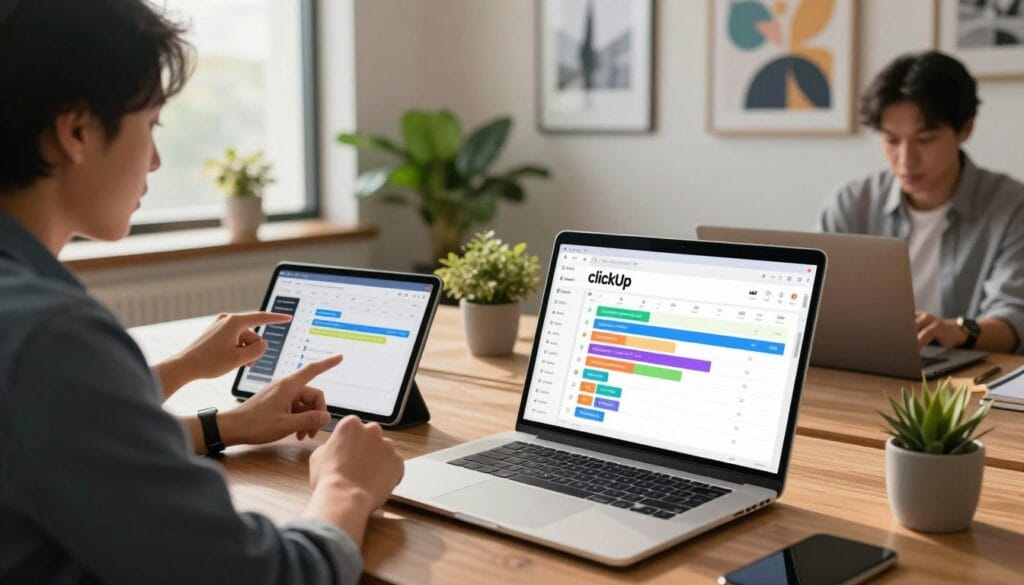
The right tools can transform how teams manage their tasks and collaborate on projects. ClickUp stands out as a highly rated platform, achieving a score of 4.86 out of 5 on project-management.com. It is particularly beneficial for mid and large teams seeking detailed, customizable task hierarchies. ClickUp offers one of the most generous free plans in the industry, allowing unlimited users and access to premium project views through a credit system.
Overview and Key Capabilities
ClickUp excels when users need to design task boards that match specific workflows. The platform allows for the addition of custom fields, categories, and built-in time tracking. With over 1,000 templates available, teams can quickly map standard workflows, minimizing the need to start from scratch.
Task Management and Automation
This software features a multi-level task structure, where one parent task can contain several layers of subtasks. Each subtask can be assigned to different roles, enhancing accountability. Additionally, automations notify the next person in sequence immediately when a predecessor task is completed. This keeps momentum steady on shared deliverables and enables offline task creation that syncs upon reconnection.
Pricing and Free Plan Benefits
ClickUp’s pricing structure is designed to accommodate various needs:
| Plan | Price | Features |
|---|---|---|
| Free Forever | Unlimited users | Kanban view, sprint management |
| Unlimited | $7/user/month | Integrations, Gantt charts, time tracking, portfolios |
| Business | $12/user/month | Timeline view, workload management, reporting |
| Enterprise | Custom | SSO, advanced permissions |
While the free plan is limited to 60MB storage, it provides significant functionality, allowing teams to explore premium project views through a credit system. AI features may incur additional fees.
Pros and Cons
ClickUp offers numerous advantages:
- Generous free plan: Unlimited users and access to premium project views through credits.
- Offline task creation: Sync capability ensures no loss of progress.
- Rich task options: Tailor work to preferred workflows with extensive customization.
However, there are some drawbacks:
- The interface can feel cluttered without customization.
- Extra fees apply for AI access.
- The free plan’s storage limit of 60MB may be restrictive for larger projects.
In conclusion, ClickUp is an excellent choice for budget-conscious teams seeking a powerful platform with advanced functionality available for experimentation before committing to a paid upgrade.
3. Jira – Best for Agile Software Delivery
Selecting the right tools can significantly impact how effectively your team delivers projects. Jira is highly regarded as a leading choice for agile software delivery, earning a rating of 4.82 out of 5 from project-management.com. This platform is designed specifically for IT departments and software development teams that utilize agile methodologies.
Jira is ideal for teams that need features such as form-based ticket submission, sprint backlogs, and comprehensive release management. Its deep support for Scrum and Kanban methodologies makes it a go-to tool for managing agile projects effectively.
Target Audience and Use Cases
The primary users of Jira are small to large IT teams looking for a robust project management solution. It is especially beneficial for software development teams that require:
- Issue escalation through form-based ticket submission
- Planning work with sprint backlogs
- Prioritizing features via roadmapping
- Comprehensive release management capabilities
Agile Project Features and Reporting
Jira excels in agile project management with its various features. Scrum boards help teams track progress through:
- Burndown and velocity charts, which show work remaining or completed across sprints
- Cumulative flow diagrams, revealing how many items are in each status
- Control charts, displaying cycle time for specific versions or sprints
The Insights tool aggregates historical performance data, aiding in data-driven decision-making during sprint planning and retrospectives.
Pricing Structure
Jira offers a flexible pricing structure that caters to different team sizes:
| Plan | Price | Features |
|---|---|---|
| Free | Up to 10 users | Reports, list, timeline, and calendar views |
| Standard | $9.05/user/month | AI agents, guest access, user roles |
| Premium | $18.30/user/month | Approval processes, dependency management |
| Enterprise | Custom | Advanced admin controls, cross-product insights |
Pros and Cons
Jira has several advantages, including:
- Comprehensive agile feature set with story points, epics, sprints, and burndown charts
- Integration capabilities with up to 3,000 third-party tools
- Robust reporting tools that enhance project tracking
However, there are some drawbacks:
- A steep learning curve, particularly for beginners
- Limited collaboration tools compared to all-in-one platforms
- Developer-centric jargon that may be unfamiliar to non-technical users
In conclusion, Jira is best suited for software delivery teams that need specialized agile project management tools and are willing to invest time in learning the platform’s terminology and workflows.
4. Miro – Best for Whiteboard-Style Project Planning
Miro transforms the traditional project planning process into an engaging, collaborative journey. This platform is highly rated, earning a score of 4.7 out of 5 from project-management.com. It provides a virtually limitless canvas, making it ideal for remote and creative teams.
Miro enables real-time co-creation, allowing every team member to contribute simultaneously. Features like sticky notes, freehand sketches, and diagrams keep sessions lively. With 7,000 pre-made templates and over 5,000 community-made templates, teams rarely start from scratch.
Collaboration Features and Templates
Miro’s collaboration tools include:
- Attention Management: Guides participants to specific areas of the board.
- Talktrack: Records audio or video walkthroughs for asynchronous collaboration.
- Voting Tools: Engage participants in decision-making processes.
- Automatic Board Version Histories: Keeps track of changes made over time.
Use Cases for Remote and Creative Teams
Miro is particularly beneficial for:
- Facilitating ideation with distributed teams through asynchronous comments.
- Enabling creative brainstorming sessions without the need for live meetings.
- Pinning documents and prototypes, layering in diagrams and timelines.
Pricing Plans and Limits
Miro offers several pricing plans:
| Plan | Price | Features |
|---|---|---|
| Free | Unlimited members | Three editable boards, templates access |
| Starter | $8/user/month | Unlimited boards, version history, video calling |
| Business | $16/user/month | Unlimited guests, diagramming shapes |
| Enterprise | Custom | Centralized account management |
Pros and Cons
Some advantages of using Miro include:
- Access to over 5,000 community-made templates.
- Drag-and-drop functionality for easy task addition.
- Rich whiteboard features that promote free-flowing ideation.
However, there are some drawbacks:
- System lags can occur when working on large boards.
- Boards may become cluttered without proper management.
- The interface can be intimidating for beginners.
In conclusion, Miro is recommended for teams that prioritize equal participation and interactive brainstorming sessions over traditional task tracking and project workflows.
5. Smartsheet – Best for Portfolio Reporting
Smartsheet stands out as a leading option in the realm of project management tools, particularly known for its robust portfolio reporting capabilities. Rated 4.62 out of 5 by project-management.com, this platform is designed for mid to large teams that require comprehensive visibility into how multiple projects connect across a wider portfolio. With real-time dashboards, Smartsheet surfaces active projects, highlights items at risk, and enables users to monitor overall portfolio health effectively.
Portfolio Management Capabilities
Smartsheet offers a spreadsheet-style interface that provides a familiar structure for teams transitioning from Excel. This design facilitates scaling portfolio management through a demand intake process. Every new request flows into a central pipeline, allowing teams to capture project details through forms or by connecting the Control Center to third-party systems that hold project data. This integration gives leadership a single reliable source of truth for both incoming demand and active delivery.
Advanced Reporting and Control Center
The platform’s advanced reporting features are enhanced by the Control Center add-on. This tool automates project creation by defining and standardizing core assets like project plans, executive dashboards, budgets, and RAID logs. It implements changes and aggregates portfolio reporting so that project structures, workflows, and rollup metrics are consistently recreated every time someone approves a new project. Additionally, Work Insights highlights items in progress, week-over-week ticket trends, and average resolution times, providing teams with critical insights.
Pricing Options
Smartsheet offers several pricing plans to cater to various organizational needs:
| Plan | Price | Features |
|---|---|---|
| Pro | $9/user/month | Unlimited users, project views, sheets |
| Business | $19/user/month | Adding free guests, timeline view, workload tracking |
| Enterprise | Custom | Includes AI formulas, work insights, SSO |
| Advanced Work Management | Custom | Includes Control Center and dynamic view |
Pros and Cons
Smartsheet has several advantages:
- Highly customizable: The spreadsheet structure allows for extensive customization.
- Rich file approval functionality: Streamlines the approval process for documents.
- Enterprise-level security: Ensures data protection and compliance.
However, there are some drawbacks:
- No free plan available, which may deter smaller teams.
- The depth of features can be overwhelming for small teams.
- AI capabilities require an additional paid upgrade.
In conclusion, Smartsheet is highly recommended for organizations managing complex portfolios. It provides essential visibility into how multiple projects connect, where standardized project creation and reporting are vital for governance.
6. Wrike – Best for Creative Production

For teams engaged in creative work, the right project management solutions can enhance productivity and collaboration. Wrike has earned a rating of 4.55 out of 5 from project-management.com, making it a top choice for enterprise teams. This platform effectively manages the entire content lifecycle, from initial briefs to final approvals, thanks to its specialized proofing tools and digital asset management integrations.
Creative Team Features and Proofing Tools
Wrike enables teams to kick off projects with customizable briefs that define scope, goals, and timelines. The built-in proofing tool allows reviewers to mark up design files directly on the assets, with all comments automatically logged to the task. Stakeholders can approve or reject work within the same workflow, comparing original and updated versions over time. Additionally, external guest reviewers can be invited with controlled permissions and access expiration dates.
Workflow Customization and Collaboration
This platform provides advanced project management features, including Gantt charts, custom dashboards, and time tracking. Wrike serves as a balanced solution, offering varied functionalities for creative teams working with multiple collaborators. However, first-time users may find the interface complex and unintuitive. Notifications can also become repetitive and overwhelming without proper configuration of email settings.
Pricing and Seat Minimums
Wrike offers a free plan with unlimited seats, making it accessible for teams. Paid plans start at $10 per user per month when billed annually. However, users often express frustration over deceptive pricing practices. The advertised per-user rate can be misleading, as plans typically require minimum purchases of 5 users at a total of $49 per month. Expanding to 6 users necessitates paying for 10 users, with plans going in increments of 5 or 10 without clear disclosure during the sales process.
Pros and Cons
Some advantages of using Wrike include:
- Advanced project management features like Gantt charts and custom dashboards.
- Robust proofing tools that enhance the creative production process.
- Time tracking capabilities for better resource management.
However, there are also notable drawbacks:
- The interface can be complex and unintuitive for new users.
- Lacks financial indicators, invoicing, budgeting, or billing features.
- Notifications can be repetitive and overwhelming.
- Pricing is often higher compared to competitors, with deceptive seat minimum requirements.
In conclusion, Wrike is highly recommended for enterprise creative teams that require robust proofing and approval workflows. However, potential users should test the platform thoroughly with a short-term commitment before signing long-term contracts due to its complex pricing structure.
| Plan | Price | Features |
|---|---|---|
| Free | Unlimited users | Basic features, unlimited seats |
| Paid | $10/user/month | Advanced features, Gantt charts, proofing tools |
Additional Noteworthy Project Management Tools to Consider
This section provides a curated overview of four additional noteworthy project management tools that serve specific niches and use cases. These alternatives go beyond the top six platforms, addressing specialized needs including AI-powered workflows, professional services management, personal task organization, and database-driven project management.
Taskade – Leveraging AI Features
Taskade is recommended for mid and large teams looking to leverage AI features. Starting at just $6 for three users, it offers AI-powered capabilities that help teams automate workflows, generate content, and streamline project planning. This collaborative workspace combines task management with real-time communication, enhancing productivity and efficiency.
Teamwork – Ideal for Professional Services
Teamwork is ideal for professional services firms and mid to large-size agencies. With a starting price of $10.99 per user per month, it includes comprehensive time tracking, resource management, and budget tracking features. These functionalities are often absent from many project management tools like Asana, Trello, or monday.com. Teamwork is the top choice for client work where profitability analysis and billable hour tracking are essential, complete with pre-built report templates for time tracking, budget summaries, and task breakdowns.
Todoist – Best for Personal Use and Solos
Todoist is the best project management tool for personal use and solo users, starting at $5 per user per month. It offers a clean and simple interface for individual task management without the complexity of team-oriented platforms. This makes it ideal for freelancers and independent professionals who need a straightforward task tracker.
Notion – Combining Project Databases with Workflow
Notion is recommended for solo use and small teams as the best for project databases, starting at $10 per user per month. It features a flexible architecture that allows users to build custom project databases, wikis, and documentation alongside task management in a single workspace. This combination enhances workflow automation and overall productivity.
These additional tools round out the project management software landscape, each serving distinct user intents that the top six platforms may not fully address.
| Tool | Starting Price | Best For |
|---|---|---|
| Taskade | $6 for 3 users | AI features for mid and large teams |
| Teamwork | $10.99/user/month | Professional services management |
| Todoist | $5/user/month | Personal use and solo users |
| Notion | $10/user/month | Project databases and workflow |
Best Practices for Implementing Project Management Software Effectively
Implementing effective strategies is essential for maximizing the benefits of project management tools. Without a clear approach, even the most advanced software can fail to deliver results. Here are some critical best practices that can determine the success of your implementation.
Setting Clear Project Objectives
Establishing clear project objectives is crucial. Vague goals can lead to confusion and inefficiency. Instead, set specific measurable outcomes. For example, aim to increase qualified leads by 25% by Q4 or launch a product by March 15 with 95% feature completion. This clarity helps align tasks and deadlines with your overall mission, making it easier to prioritize work and track progress against defined benchmarks.
Training and Onboarding Your Team
Effective training and onboarding are vital for successful adoption. Aim for 80% or more daily usage within 30 days of rollout. New team members should be able to create a project and assign a task within 15 minutes of first use. Complex systems that require 1-2 weeks of training or 5-10 hours of admin configuration can lead to delays and frustration. Measure your current coordination overhead before adoption and again after 30 days to verify at least 5 hours saved weekly per person.
Maintaining Consistent Workflows and Hygiene
Maintaining consistent workflows is essential for long-term success. Break larger projects into tasks under 8 hours, and use folders, labels, or categories to group related tasks. This organization aids in easy access and filtering. Additionally, perform quarterly automation clean-ups to review lists for unnecessary automations. This practice prevents hitting count limitations based on pricing tiers and keeps your project management software running efficiently.
In conclusion, the ROI of project management software comes not just from the software cost but from the time saved in coordination. When implemented correctly, teams can save between $600 to $3,000 per month per person, yielding a 3-15x ROI in time savings alone. Following these best practices consistently is key to unlocking the full potential of your project management tools.
Pricing and Licensing Trends in Project Management Software for 2026
The landscape of pricing and licensing in project management tools is rapidly evolving, making it crucial for teams to stay informed. Understanding the nuances between free plans, paid subscriptions, and hidden costs is essential for making an informed purchasing decision that aligns with both budget constraints and feature requirements.
Understanding Free Plans vs Paid Subscriptions
Free plans vary significantly among project management tools. For instance, ClickUp offers a generous free plan with unlimited users and access to premium project views through a credit system. In contrast, Miro provides unlimited members but limits editable boards to three. Meanwhile, some platforms like Smartsheet do not offer a free plan but provide a 30-day free trial. This trial allows teams to explore features before committing financially.
ROI calculations show that software costs typically range from $40 to $200 per month per person. In contrast, coordination time saved can be between $600 and $3,000 per month per person, yielding a 3-15x ROI in time savings alone.
User Licensing and Seat Requirements
User licensing can be complex. Some vendors, such as Wrike and Asana, enforce minimum seat purchases in blocks of 5 or 10 users without clear disclosure during the sales process. This means the advertised per-user rate can be misleading; for example, a team of six may have to pay for ten users. Such requirements are often buried in terms and conditions, making it critical for buyers to clarify seat minimums before investing time and energy in a platform.
Common Pricing Tiers and Features Included
Common pricing tiers across the industry typically start with entry-level paid plans between $5 and $10.99 per user per month. These plans usually include core task management and collaboration features. Mid-tier plans, priced between $10 and $19 per user per month, often add functionalities like Gantt charts, time tracking, and integrations. Enterprise plans come with custom pricing for advanced features such as portfolio reporting, resource management, SSO, and AI capabilities, which may require additional paid upgrades beyond the base subscription.
Before committing, it is advisable for buyers to test 2-3 real projects during a 14-day trial. They should carefully review pricing pages for seat minimums and feature limitations. Additionally, calculating the total cost of ownership, including any required add-ons for essential features like time tracking or AI, is crucial for making a final decision.
| Tool | Starting Price | Free Plan Availability | Key Features |
|---|---|---|---|
| monday work management | $9/user/month | Yes, for 2 users | Task management, automation |
| ClickUp | $7/user/month | Yes, unlimited users | Custom fields, Gantt charts |
| Jira | $9.05/user/month | Yes, up to 10 users | Agile project management, reporting |
| Miro | $8/user/month | Yes, unlimited members (3 editable boards) | Collaboration tools, templates |
| Smartsheet | $9/user/month | No, but offers a 30-day trial | Portfolio reporting, resource management |
| Wrike | $10/user/month | Yes, but with minimum seat requirements | Proofing tools, Gantt charts |
| Taskade | $6 for 3 users | Yes | AI features, task management |
| Teamwork | $10.99/user/month | No | Time tracking, budget management |
| Todoist | $5/user/month | Yes | Task organization, simple interface |
| Notion | $10/user/month | Yes | Project databases, workflow automation |
Conclusion
The choice of project oversight tools can dramatically shape team dynamics and success. Each platform has its strengths tailored to specific needs. For instance, monday work management excels in visual planning, while ClickUp offers customizable task hierarchies.
Jira is perfect for agile teams, and Miro supports creative brainstorming. Smartsheet shines in portfolio reporting, while Wrike caters to creative production with robust workflows.
Additional tools like Taskade leverage AI, Teamwork is ideal for professional services, Todoist suits personal use, and Notion combines project databases with workflow automation.
Ultimately, the ROI of these tools can be substantial, with potential time savings of 3-15x. To make an informed decision, shortlist 2-3 options, test them with real projects during a 14-day trial, and measure your current coordination overhead. This approach ensures you select the right tools that align with your team’s unique needs.


 By
By