

Index funds serve as a beginner-friendly gateway to building long-term wealth through the stock market. They allow investors to grow their money without needing expert stock-picking skills. This guide will walk you through everything from understanding index funds to opening an investment account and making your first purchase.
As of 2023, index funds represent 48% of assets managed by investment firms, a significant increase from just 19% in 2010. This growth highlights their mainstream adoption among investors. By mirroring the performance of specific market benchmarks like the S&P 500, these funds offer a passive investment strategy.
Worried about needing a lot of money to start? Many funds now allow fractional share purchases, letting you begin with as little as $10 to $100. This article will cover definitions, mechanics, types, benefits, risks, and a practical guide for getting started with index fund investing.
By the end of this guide, you will have a clear roadmap for choosing the right index funds that align with your financial goals and risk tolerance. Understanding expense ratios and fees is crucial, as even small differences can significantly impact your long-term returns due to compounding.
Index fund investing is a time-tested way to participate in the overall market’s growth while minimizing costs and maintenance effort.
Key Takeaways
- Index funds are an accessible way to invest in the stock market.
- They have become increasingly popular, representing a large portion of managed assets.
- Investing can start with minimal amounts, making it easier for newcomers.
- This guide will cover essential aspects of index fund investing.
- Understanding fees and expenses is vital for maximizing returns.
What Are Index Funds?
A type of mutual fund or ETF, index funds aim to replicate the performance of a designated market index. This strategy allows investors to gain exposure to a broad range of stocks without the need for extensive market analysis.
Index funds are structured to track the performance of specific financial indexes, such as the S&P 500 or the Dow Jones Industrial Average. A financial index serves as a numerical benchmark that represents a group of securities. This helps investors quickly assess how different segments of the stock market are performing.
It’s important to distinguish between investment vehicles and strategies. A mutual fund or ETF is the vehicle, while an index fund represents a passive strategy within that vehicle. Unlike actively managed funds, where professional managers select individual stocks, index funds simply aim to match the performance of the benchmark.
Key characteristics of index funds include:
- Broad market exposure: Index funds often cover a wide array of companies, providing diversification.
- Low portfolio turnover: This reduces costs and minimizes the impact of taxes on returns.
- Passive management: By not relying on stock-picking, index funds reduce human bias and error.
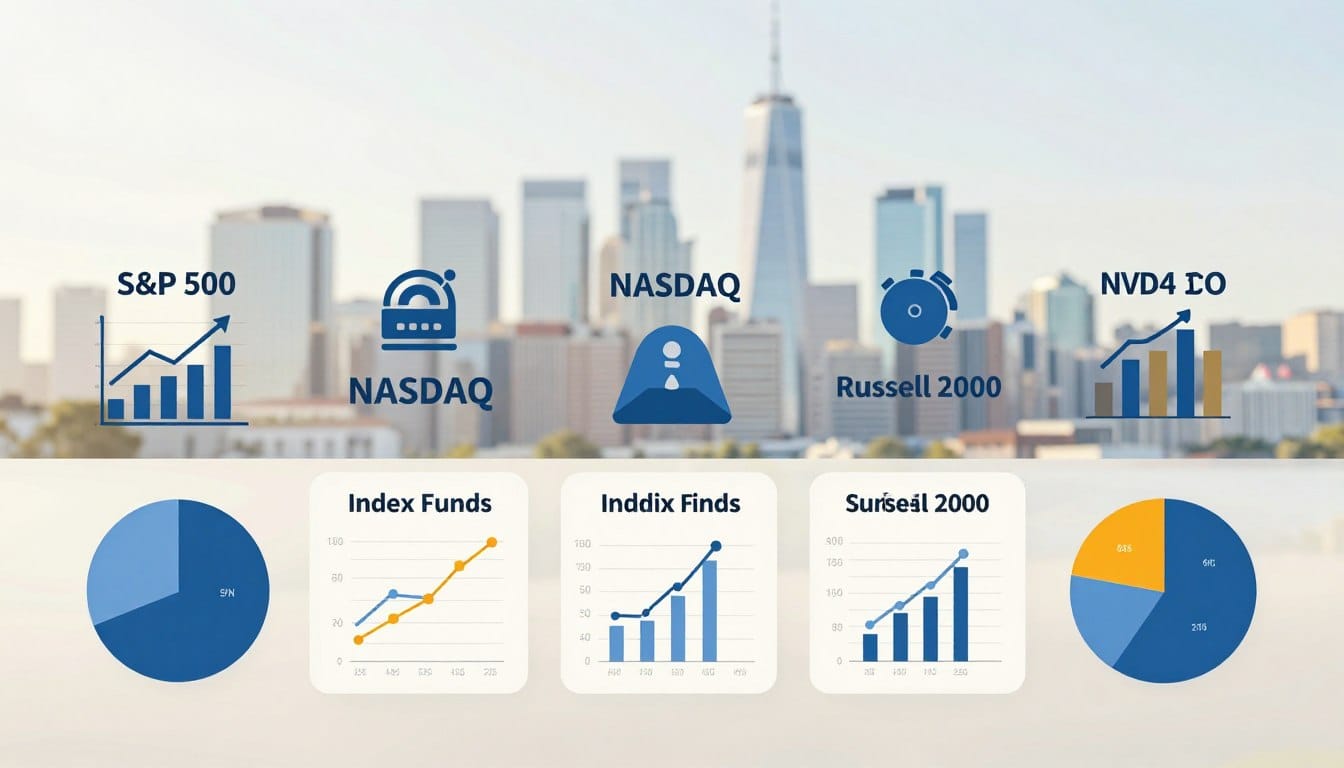
Some of the most common market indexes tracked by index funds include:
| Market Index | Description |
|---|---|
| S&P 500 | Tracks 500 of the largest U.S. companies. |
| Dow Jones Industrial Average | Tracks 30 large-cap publicly owned companies. |
| Nasdaq Composite | Focuses on technology and growth companies. |
| Russell 2000 | Tracks U.S. small-cap companies under $2 billion market cap. |
| NYSE Composite | Tracks all common stocks on the New York Stock Exchange. |
| Wilshire 5000 | Tracks every U.S.-headquartered stock. |
Investors cannot invest directly in an index but can invest in an index fund that aims to track the performance of that index. This approach provides accessible market exposure. Vanguard introduced index funds to individual investors nearly 50 years ago, making them a cornerstone of low-cost, passive investing.
How Do Index Funds Work?
The mechanism behind index funds is rooted in a passive investment strategy. Instead of trying to outperform the market, these funds buy all or a representative sample of the stocks or bonds within the index they track. This approach aims to mirror the growth of a specific market index with minimal effort.
Fund managers replicate an index by holding the same stocks or bonds in proportional weights. This ensures that the fund’s performance closely mirrors the benchmark’s movements. The effectiveness of this strategy is measured by a concept known as tracking error. This term refers to the misalignment between the fund’s performance and its target index. A lower tracking error indicates that the fund’s returns are very close to the benchmark.
Expense ratios are another important aspect of index funds. These ratios represent the annual cost paid to the fund manager, expressed as a percentage of the fund’s holdings. Generally, index funds charge between 0.05% and 0.27%. For instance, Vanguard’s average index ETF and mutual fund expense ratio stands at 0.04%, significantly lower than the industry average of 0.17% as of December 2025.
In contrast to index funds, actively managed funds rely on portfolio managers who use research and personal judgment to select securities. This can introduce the risk of underperformance. Additionally, index funds typically distribute fewer taxable capital gains due to less frequent trading, enhancing tax efficiency for investors.
Passive investing is based on the premise that the overall market will grow steadily over time. This makes index funds a long-term investment strategy, often utilized in retirement accounts. Notably, data shows that over a ten-year period, a significant majority of Vanguard index funds outperformed their peer-group averages, highlighting the effectiveness of low-cost passive strategies.
When the S&P 500 index increases in value, it doesn’t imply that all 500 companies have shown gains. Instead, enough companies must perform well to elevate the total average, and the value of the index fund reflects this aggregate performance.
Types of Index Funds and Common Indexes
Understanding the various types of index funds is essential for making informed investment choices. Each type offers unique characteristics that can help investors achieve their financial goals.
Broad Market Index Funds
Broad market index funds aim to represent the entire stock market. They include companies of all sizes and industries, providing investors with a comprehensive view of market performance. A popular example is the S&P 500, which tracks 500 of the largest U.S. companies.
Sector-Specific Index Funds
Sector-specific index funds focus on particular industries, such as health care, technology, or consumer goods. These funds offer targeted exposure, which can lead to higher share-price volatility. Investors looking to capitalize on specific market trends often find these funds appealing.
Domestic vs. International Index Funds
Domestic index funds track U.S.-based investments, while international index funds follow markets outside the United States. For instance, the MSCI All Country World Index ex USA includes large- and mid-cap companies from various countries. This distinction allows investors to diversify their portfolios across different geographical regions.
Bond and Dividend Index Funds
Bond index funds invest in bonds that comprise indexes like the Bloomberg US Aggregate Bond Index. These funds aim to match the performance of various types of U.S. bonds, including corporate and government bonds. Dividend index funds, on the other hand, track companies that pay out higher dividends, allowing investors to benefit from regular income distributions.
Socially Responsible and Thematic Index Funds
Socially responsible index funds apply exclusionary screens, removing companies that do not meet certain ethical standards. This includes companies involved in environmentally harmful practices. Thematic index funds focus on specific investment themes, such as sustainability or technology innovation, providing targeted investment opportunities.
With a wide array of index funds available, investors can tailor their portfolios to suit their individual needs. Combining different types of funds can enhance diversification, providing both stability and targeted growth potential.
Benefits of Investing in Index Funds
Investing in index funds provides numerous advantages that appeal to both novice and seasoned investors. These benefits can significantly enhance the investment experience while minimizing risks and costs.
Low Costs and Fees
One of the most celebrated advantages of index funds is their low costs. For instance, the Fidelity 500 Index Fund has a gross expense ratio of just 0.015% as of April 29, 2025. In contrast, actively managed mutual funds often charge around 1% or more annually, which is nearly 70 times higher.
Additionally, some index funds, like the Fidelity ZERO Total Market Index Fund, boast 0% net and gross expense ratios as of December 30, 2025. This accessibility allows more individuals to participate in the market without high costs.
Diversification and Reduced Risk
Diversification is another key benefit. With a single purchase of an index fund, investors gain immediate exposure to hundreds or even thousands of securities. This strategy helps reduce the risk associated with holding individual stocks, as the performance of one company is less likely to impact the overall fund significantly.
Tax Efficiency
Index funds are also known for their tax efficiency. They typically distribute fewer taxable capital gains because portfolio managers trade less frequently than those managing actively managed funds. This feature can lead to lower tax liabilities for investors.
Reduced Manager Bias and Maintenance
Another advantage is the reduction of manager bias. Index fund managers simply replicate the index, avoiding subjective decisions influenced by emotions or market stress. This passive approach requires minimal maintenance, making index funds ideal for long-term wealth building.
Furthermore, the difference in fees can have a significant impact on returns over time. For example, the disparity between a 2% expense ratio and a 0.02% expense ratio may seem small initially, but it becomes substantial due to compounding interest.
Vanguard index funds, for instance, are designed to pass along economies of scale, lowering the cost of investing and allowing investors to retain more of their returns. While diversification does not guarantee profits or protect against losses, it remains a vital strategy for managing investment risk.
In conclusion, the combination of low costs, broad diversification, tax efficiency, and reduced maintenance makes index funds an attractive core holding for portfolios of all sizes.
| Fund Type | Expense Ratio |
|---|---|
| Fidelity 500 Index Fund | 0.015% |
| Fidelity ZERO Total Market Index Fund | 0% |
| Actively Managed Mutual Funds | 1% or more |
Risks and Drawbacks of Index Funds

While index funds are a popular investment choice, they come with certain risks and drawbacks. Understanding these limitations is essential for making informed decisions.
Average Market Returns Only
Index funds are designed to deliver average market returns. This means they include both high-performing and low-performing securities within the tracked index. For instance, the S&P 500 has historically provided an average return of over 10% per year since 1957, before adjusting for inflation, taxes, or investment fees. However, it’s important to remember that past performance does not guarantee future results.
Tracking Errors and Limitations
Tracking errors can occur when the fund does not perfectly align with its target index. A low tracking error indicates that returns closely mirror the benchmark, while a high tracking error shows a noticeable difference. Investors should seek funds with stable and low tracking differences over time.
No Downside Protection or Investment Control
Another significant drawback is the lack of downside protection. During market downturns, index funds typically decrease in value alongside the market. Unlike actively managed funds, which may attempt to sell off stocks to minimize losses, index funds hold onto their investments regardless of market conditions. This can be a concern for risk-averse investors.
Investment Minimums and Other Costs
Some index funds require a minimum investment of $3,000 or more, which can be a barrier for new investors. Fortunately, many platforms now offer fractional shares, allowing entry with as little as $10 to $100. Additionally, while index funds are generally low-cost, they are not always free. Investors should carefully examine expense ratios and any additional fees before committing their money.
It’s also important to note that investors have no control over the specific holdings within an index fund. This lack of control can be frustrating for those who wish to exclude certain companies or industries from their portfolios.
In summary, while index funds offer a straightforward investment approach, they are not without risks. All investing carries the possibility of losing money, and diversification does not guarantee profits or protect against losses. Understanding these factors is crucial for anyone considering index funds as part of their investment strategy.
How to Invest in Index Funds for Beginners
The journey into index fund investing begins with a crucial first step: opening an investment account. This account can be a retirement account, like an Individual Retirement Account (IRA), or a standard brokerage account for more flexibility.
Opening an Investment Account
For those new to investing, starting with a 401(k) or IRA is common. Even if you have never logged in or made a selection, your account is likely already invested in something. You can change current investments or update future contributions from a list of available funds.
When exploring retirement plan menus, look for “INDEX” in the fund name. Clicking on the name will provide you with more information, such as historical performance and expense ratios.
Investing Via 401(k)s and IRAs
Retirement accounts often offer a selection of mutual funds, including index funds. These options may be limited, but they are a great way to start investing for your future.
Using Brokerage Accounts for More Flexibility
Standard brokerage accounts offer more flexibility with no contribution or withdrawal limits. They provide access to nearly any index fund available on the market. However, remember that selling investments triggers capital gains taxes.
Determining How Much Money You Need to Start
Many modern platforms allow fractional share purchases, making it possible to start investing with as little as $10 to $100. Some traditional mutual funds may require minimum investments of $3,000 or more, so it’s essential to check before committing.
Choosing the Right Index Funds for Your Goals
When selecting index funds, consider what the fund tracks, its objectives, historical performance, and expense ratios. This will help you align your investments with your financial goals.
Researching which broker to use is also crucial. Look for the number of index funds available, overall fees, and how user-friendly the investment platform is before opening an account.
Finally, if you prefer a hands-off approach, consider using robo-advisors. These affordable digital financial services automate investing in index funds.
Always remember to transfer cash into your account first. Then, use that money to buy shares in your chosen index funds. Consistently contributing over time is key to building wealth.
Understanding Expense Ratios and Fees in Index Funds
Expense ratios play a critical role in determining the overall cost of investing in index funds. Understanding these costs is essential for maximizing your investment returns.
An expense ratio is the total annual fund operating expenses expressed as a percentage of assets. This represents the yearly cost investors pay to the fund manager for owning the fund. For example, if an investor has $10,000 in a fund with a 2% expense ratio, they pay $200 each year. This amount directly reduces their investment returns.
Typical Fees for Index Funds vs. Actively Managed Funds
Index fund expense ratios generally range from 0.05% to 0.27%. Vanguard’s average expense ratio is notably low at 0.04% as of December 2025. In contrast, actively managed mutual funds might charge expense ratios of 1% or more, which is nearly 70 times higher than the Fidelity 500 Index Fund at 0.015%.
How Fees Impact Your Long-Term Returns
The difference between a 2% and a 0.02% expense ratio may seem small initially, but it can become a significant factor over time due to compounding interest. For instance, this difference can amount to tens of thousands of dollars over an investment lifetime.
Some index funds now offer 0% expense ratios, such as the Fidelity ZERO Total Market Index Fund, which eliminates management costs entirely for investors. However, it’s crucial to remember that all funds have various fees wrapped into the expense ratio, and investors should be able to see this information clearly wherever they invest.
While expense ratio cost should not be the only determining factor in fund selection, it is one of the most important metrics for long-term investment success. Vanguard introduced index funds to individual investors nearly 50 years ago, aiming to lower the cost of investing. Their funds are designed to pass along economies of scale.
In conclusion, understanding and minimizing expense ratios is one of the most actionable steps beginners can take to maximize their long-term returns from index fund investing.
Conclusion
Investing in index funds can open doors to financial growth. They offer a low-cost, diversified, and beginner-friendly way to engage with the stock market. The passive strategy behind these funds has shown that they often outperform actively managed options over time.
Starting does not require a large investment, thanks to fractional shares and zero-minimum funds. Beginners should consider opening an investment account, whether through a 401(k), IRA, or a standard brokerage account for more flexibility.
Focus on expense ratios when selecting index funds, as even small differences can significantly affect long-term returns. While these funds have risks, including average market returns and no downside protection, they remain reliable tools for building wealth.
Align your choices with personal financial goals and risk tolerance. By applying the knowledge gained from this guide, you can confidently embark on your index fund investing journey. The shift toward these funds reflects a new era in wealth-building, with index funds now comprising nearly half of all managed assets.


 By
By