


Welcome to an exciting journey into the world of blockchain technology! Ethereum stands out as a powerful platform that enables developers to create decentralized applications, often referred to as dApps. Unlike Bitcoin, which primarily serves as a digital currency, Ethereum offers a unique environment powered by smart contracts.
Proposed by Vitalik Buterin in 2013 and launched in 2015, this platform has become a cornerstone of the cryptocurrency landscape. It allows users to engage with a vast network where transactions are fueled by its native cryptocurrency, Ether (ETH).
This guide is tailored for absolute newcomers, simplifying complex concepts and building your confidence. As you explore this resource, you’ll learn why Ethereum is crucial in the crypto world and how it differentiates itself from other digital currencies.
From understanding the origins of Ethereum to practical tips on using wallets and engaging with decentralized finance, this article aims to equip you with the knowledge needed to navigate this innovative space.
Key Takeaways
- Ethereum is a blockchain-based platform for building decentralized applications.
- It differs from Bitcoin by offering programmable smart contracts.
- Ether (ETH) is the native cryptocurrency that powers transactions.
- This guide breaks down complex concepts for beginners.
- Hands-on learning is encouraged through small test transactions.
- Security and risk management are essential when using the network.
Introduction to Ethereum: What Beginners Need to Know
Explore the transformative realm of blockchain, highlighting Ethereum’s unique contributions. Proposed by Vitalik Buterin in 2013, this platform officially launched in 2015. Buterin envisioned a blockchain with a full scripting language, enabling complex transactions and applications beyond simple payments.
Co-founders Gavin Wood and Joseph Lubin played significant roles in its development. Wood authored the Ethereum yellow paper and created Solidity, the programming language for smart contracts. The Ethereum Foundation successfully oversaw a crowdfunding campaign, bringing this vision to life.
The Origins and Vision of Ethereum
Vitalik Buterin’s vision was to create a versatile platform. Unlike Bitcoin, which has a supply cap of 21 million BTC and an average block time of about 10 minutes, Ethereum operates with approximately 12-13 second block times and no fixed supply cap. This flexibility allows for a broader range of applications.
What is Ether (ETH)?
Ether (ETH) is the native cryptocurrency of the Ethereum blockchain. It serves as the fuel for every transaction and smart contract execution on the network. ETH is not just a digital currency; it is a utility asset necessary for interacting with decentralized applications, paying gas fees, and participating in staking after the Merge.
Ethereum vs. Bitcoin: Key Differences
Understanding the differences between Ethereum and Bitcoin is crucial. Bitcoin primarily functions as a store of value with limited scripting capabilities. In contrast, Ethereum operates as a programmable platform that supports complex smart contracts and decentralized applications.
Key technical distinctions include:
| Feature | Ethereum | Bitcoin |
|---|---|---|
| Average Block Time | 12-13 seconds | ~10 minutes |
| Supply Cap | No fixed cap | 21 million BTC |
| Consensus Mechanism | Proof of Stake | Proof of Work |
| Energy Consumption | Reduced by ~99.95% | N/A |
By understanding these differences, beginners can appreciate why Ethereum’s Turing-complete Ethereum Virtual Machine enables a world of applications extending beyond simple peer-to-peer value transfers. Additionally, the concept of gas fees, denominated in gwei, is crucial for later discussions on transaction costs.
Ethereum’s design as a shared state machine means every operation updates a globally verifiable ledger. This fundamental concept distinguishes it from traditional banking systems, offering transparency and security.
By the end of this section, readers will grasp what Ether is, where Ethereum originated, and why its flexible, contract-driven architecture has attracted millions of users and developers worldwide.
Understanding the Ethereum Network and Blockchain
Dive into the intricate workings of the Ethereum network and its underlying blockchain. This section will clarify how the Ethereum blockchain operates and the essential components that support its decentralized nature.
The Ethereum Blockchain Explained
The Ethereum blockchain functions as an append-only log. Each block is cryptographically linked to the previous one. This design ensures that historical data remains tamper-resistant and publicly verifiable by any node on the network.
Addresses on this platform are 20 bytes long, featuring a checksum to help catch typing errors. After the Merge on September 15, 2022, Ethereum transitioned to a Proof of Stake model, where validators propose and attest to new blocks.
Decentralization: Nodes and Validators
Decentralization is a core principle of the Ethereum network. Thousands of nodes are distributed worldwide, each maintaining a complete copy of the Ethereum blockchain. These nodes independently verify every transaction and smart contract interaction.
Validators play a crucial role in this ecosystem. They propose new blocks and confirm the validity of existing ones. A full validator bond requires 32 ETH, but staking pools allow smaller balances to participate.
The Role of the Consensus Layer
The Ethereum network operates through two main components: the Execution Layer and the Consensus Layer. The Execution Layer processes transactions, while the Consensus Layer ensures that all participants agree on the current state of the blockchain.
Blocks are produced approximately every 12 seconds, allowing for quick confirmations compared to older blockchain networks. However, finality relies on multiple attestations from the validator set.
When transactions are submitted, they are ordered into blocks. This shared state of the Ethereum blockchain can be recomputed by any node using the same set of inputs, maintaining transparency and reliability.
By the end of this section, readers will understand how the Ethereum network achieves decentralized consensus without a central authority. This foundation is essential for grasping the concepts of smart contracts and decentralized applications.
| Feature | Description |
|---|---|
| Blockchain Type | Append-only log |
| Address Length | 20 bytes |
| Block Time | Approximately 12 seconds |
| Validator Bond | 32 ETH |
| Decentralization | Thousands of nodes globally |

The Complete Guide to Ethereum for Beginners: How Ethereum Works
Uncover the mechanisms that drive one of the most innovative platforms in the blockchain space. Understanding how Ethereum operates is essential for anyone looking to engage with this dynamic ecosystem. This section covers the Ethereum Virtual Machine (EVM), gas fees, and the transition to Proof of Stake.
Ethereum Virtual Machine (EVM) and Smart Contracts
The Ethereum Virtual Machine (EVM) is a decentralized runtime that executes smart contracts. Developers primarily use Solidity or Vyper to write these contracts, which then compile into EVM bytecode. Smart contracts are immutable, self-executing agreements that automatically trigger actions when predefined conditions are met.
These contracts enable trustless applications across various sectors, including finance, gaming, and supply chain management. By removing intermediaries, they create a more efficient process for executing agreements.
Gas and Transaction Fees
Every operation on the Ethereum network incurs a fee paid in gas, denominated in gwei. For example, a basic transfer typically uses 21,000 gas units. The introduction of EIP-1559 changed how fees are calculated. Now, a base fee is burned, introducing deflationary pressure on the supply of ETH, while users can add a tip to expedite their transactions during busy periods.
Beginners should learn to estimate transaction costs before signing. Setting maximum fee caps can help avoid overpaying. It’s important to note that contract interactions that write to storage cost significantly more than simple transfers.
The Merge: Transition to Proof of Stake
The Merge, which occurred on September 15, 2022, marked a significant milestone for Ethereum. This event united the Execution Layer with the Beacon Chain Consensus Layer, transitioning the network from energy-intensive Proof of Work to efficient Proof of Stake. This change reduced energy consumption by approximately 99.95% without disrupting existing applications.
Now, validators propose and attest to blocks while the EVM continues processing smart contract code as it did before the upgrade. Understanding the EVM and gas is crucial for anyone interacting with the Ethereum blockchain, as fees directly impact the cost of using decentralized applications and executing transactions.
Common Use Cases on Ethereum
Ethereum’s versatility enables a multitude of applications that are reshaping industries. From finance to gaming, this platform supports innovative solutions that benefit users globally. Below, we explore some of the most prominent use cases that highlight Ethereum’s potential.
Decentralized Finance (DeFi)
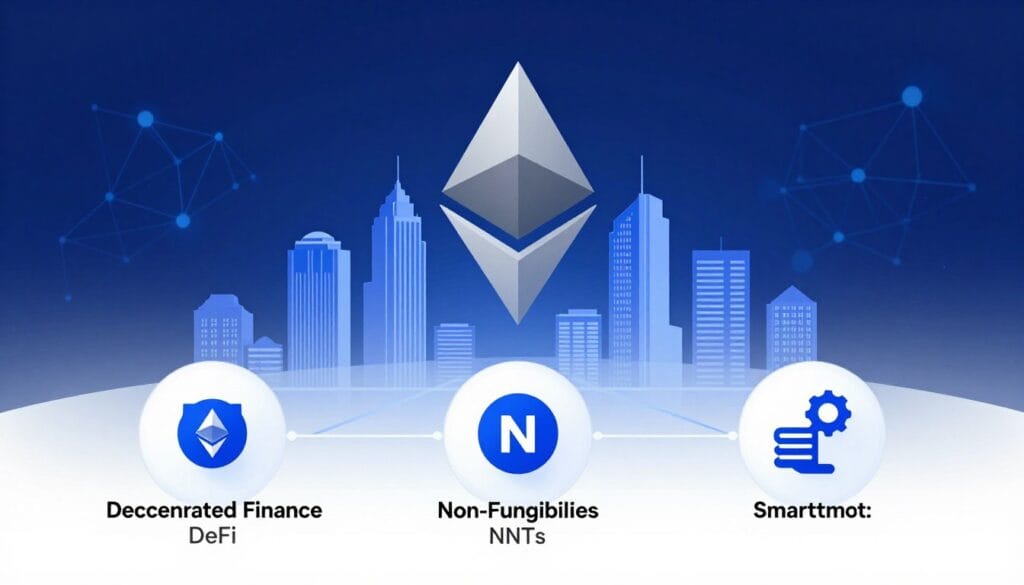
Decentralized finance is revolutionizing how individuals interact with financial services. Protocols like Uniswap, Aave, and Compound facilitate peer-to-peer lending, borrowing, and trading without traditional banks. This shift has unlocked new ways to earn yield and access financial services worldwide.
Smart contracts automatically enforce loan conditions and collateral requirements. This ensures transactions are secure and transparent, operating around the clock. Users can now trade assets directly on the blockchain, eliminating intermediaries and reducing costs.
Non-Fungible Tokens (NFTs)
The rise of non-fungible tokens has created a new market for digital collectibles and art. The ERC-721 standard powers marketplaces like OpenSea, where unique digital assets can be minted, bought, and sold. Each NFT represents verifiable ownership on the blockchain, making them desirable for collectors and creators alike.
Gaming and Virtual Worlds
Gaming platforms such as Axie Infinity and Decentraland leverage Ethereum to create player-owned economies. In these virtual worlds, in-game assets exist as tokens that can be freely traded or used across multiple applications. This model empowers players, allowing them to truly own their digital possessions.
Enterprise Blockchain Solutions
Enterprise adoption of Ethereum is growing, with solutions like Microsoft’s Azure Confidential Ledger and ConsenSys’s Hyperledger Besu. These technologies serve both public and private blockchain needs, demonstrating Ethereum’s flexibility. EY’s Nightfall Protocol focuses on privacy, catering to businesses that require confidentiality in their transactions.
Token standards like ERC-20 for fungible tokens and ERC-721 for NFTs enhance interoperability. This allows assets to move seamlessly between different apps and wallets across the ecosystem. Most activity on Ethereum comes from contract interactions that change on-chain state, whether swapping assets on a decentralized exchange or minting an NFT.
All these use cases require ETH for gas fees. Users must maintain a small balance of the native cryptocurrency even when primarily interacting with other tokens or applications. By understanding these diverse applications, readers can identify which types of decentralized applications align with their personal or professional interests.
| Use Case | Description | Examples |
|---|---|---|
| Decentralized Finance (DeFi) | Peer-to-peer financial services without intermediaries. | Uniswap, Aave, Compound |
| Non-Fungible Tokens (NFTs) | Unique digital assets with verifiable ownership. | OpenSea, Rarible |
| Gaming and Virtual Worlds | Player-owned economies and tradable in-game assets. | Axie Infinity, Decentraland |
| Enterprise Solutions | Blockchain technology for businesses and privacy. | Microsoft Azure, Hyperledger Besu, EY Nightfall |
Ethereum Fees and How They Affect Users
Understanding the costs associated with transactions on Ethereum is crucial for effective participation. Ethereum fees, often referred to as gas, are not arbitrary charges. They measure the computational and storage resources consumed by each transaction on the network.
Understanding Gas Costs
Gas costs are calculated by multiplying the amount of gas used by the effective gas price. For instance, a simple ETH transfer has a predictable cost. However, complex transactions, like those involving DeFi swaps, can vary significantly based on the specific code paths and storage writes involved.
How Network Congestion Impacts Fees
Network congestion directly affects fees. When blocks fill up, the EIP-1559 mechanism automatically raises the base fee. This adjustment creates real-time price signals that users must navigate. As demand increases, users may find themselves competing for limited block space, driving costs higher.
Strategies to Minimize Transaction Costs
To minimize transaction costs, users can adopt several practical strategies:
- Monitor gas trackers to identify periods of lower network activity.
- Set conservative maximum fee caps in wallet settings to avoid overpaying.
- Choose slower confirmation modes when time sensitivity is not critical.
Understanding the difference between the base fee that is burned and the priority tip for validators is also essential. This knowledge helps users comprehend where their ETH goes and why fee estimation tools provide ranges instead of fixed quotes.
For budgeting fees, it’s wise to maintain a small buffer of ETH for routine interactions. Avoiding time-sensitive transactions during high-activity periods, like major NFT mints, can also save costs. Additionally, users should be aware that failed transactions still consume gas. Setting appropriate fee parameters can help reduce the likelihood of costly reversions.
Lastly, Layer 2 solutions offer a longer-term strategy for reducing fees. These solutions, including rollups and sidechains, can batch transactions off the main Ethereum blockchain while inheriting its security guarantees.
By the end of this section, readers will be equipped to estimate, monitor, and minimize their transaction costs. This transforms fee management from a source of anxiety into a routine part of interacting with the network.
Security Considerations When Using Ethereum
Understanding the security landscape of Ethereum is vital for all users engaging with this innovative platform. As with any technology, risks exist, particularly when dealing with smart contracts and wallets. In this section, we will explore the key security considerations that every user should be aware of.
Smart Contract Risks and Bugs
Smart contracts are immutable code that can contain bugs or hidden edge cases. Such vulnerabilities can lead to irreversible losses, as demonstrated by the infamous DAO hack of 2016. While professional audits can significantly reduce the likelihood of these vulnerabilities, they do not eliminate risk entirely. Furthermore, if an app is upgradeable, the upgrade key introduces another risk surface that could be exploited.
Wallet Security and Best Practices
Wallet security is foundational for self-custody. Protecting your seed phrase is crucial; if lost, access to your assets is typically gone for good. Users must understand the difference between self-custody wallets, where they control their private keys, and custodial exchange accounts, where a third party manages security. This distinction highlights the trade-offs between control and convenience.
Phishing and Fraud Prevention
Phishing attacks are prevalent, often mimicking legitimate interfaces to trick users into signing transactions. A signature can grant permissions even without a direct transfer of funds. To combat this, users should verify addresses, fees, and app permissions diligently. Utilizing bookmarks for frequently visited sites instead of search engine ads can also help avoid fraudulent links.
Moreover, hardware wallets provide an essential layer of security. They keep private keys offline and require physical confirmation for each transaction, adding friction that prevents impulsive approvals. Understanding token approvals is equally important; unlimited spending permissions can expose users to risk long after the initial interaction. Regularly revoking unused permissions is a recommended practice.
By adopting a security mindset, users can treat every on-chain action as final and every signature request as a potential vector for loss. This proactive approach empowers individuals to navigate the Ethereum network with greater confidence and reduced risk.
Investing in Ether (ETH): A Beginner’s Guide
A beginner’s journey into investing in Ether starts with essential knowledge and practical steps. This section provides a straightforward guide on how to buy, store, and stake ETH while highlighting the associated risks and regulatory factors.
How to Buy and Store ETH
Buying ETH is simple, especially through reputable exchanges like Coinbase and Binance. First, you need to create an account and complete the verification process. This usually involves providing personal information and verifying your identity.
Once your account is set up, you can fund it using various methods, such as bank transfers or credit cards. After purchasing ETH, consider transferring it to a personal wallet for enhanced security. This way, you control your private keys and reduce the risk of hacks associated with custodial exchanges.
Staking ETH and Earning Rewards
Staking ETH allows you to earn rewards while contributing to the network’s security. To become a solo validator, you need a full bond of 32 ETH. However, staking pools and liquid staking derivatives enable participation with smaller amounts.
Rewards come from protocol issuance and transaction fees. Keep in mind that validators can face penalties for downtime, and there are risks associated with smart contracts in staking wrappers. Additionally, withdrawal queues may limit your access to staked ETH.
Risks and Regulatory Factors
Investing in cryptocurrency, including ETH, comes with significant risks. Prices can be highly volatile, with values rising or falling dramatically. It’s crucial to understand that past performance does not guarantee future results.
Regulatory considerations vary by jurisdiction. Some regions tax crypto-to-crypto swaps, while others focus on realized gains when converting to fiat currency. It’s advisable to maintain detailed transaction records from the first day of activity.
Tracking timestamps, amounts, and fees for every transaction is essential. Keeping records for three to seven years, based on local requirements, is a prudent practice. Consulting licensed tax professionals can provide guidance tailored to your situation.
Finally, consider strategies like dollar-cost averaging and position sizing to manage risks. Invest only what you can afford to lose, and avoid making emotional decisions during market volatility.
The Ethereum Ecosystem: Apps, Wallets, and Developers
Exploring the Ethereum ecosystem reveals a rich tapestry of wallets, applications, and contributors. This vibrant environment includes various participants who collectively drive the platform’s growth. Validators secure the network, developers create smart contracts and decentralized applications, while users interact with dApps through wallet interfaces.
Popular Ethereum Wallets and Their Features
Choosing the right wallet is essential for managing your assets. Popular options include:
- MetaMask: A browser-based wallet that allows users to interact with dApps easily.
- Ledger and Trezor: Hardware wallets that provide cold storage for enhanced security.
- Rainbow: A mobile wallet designed for user experience, ideal for everyday transactions.
Each wallet type has its own strengths. Self-custody wallets keep your keys on your device, giving you full control. In contrast, custodial wallets managed by exchanges may simplify access but involve trusting a third party.
Decentralized Applications (dApps) and Layer 2 Solutions
Decentralized applications span categories from finance to gaming and social platforms. Standards like ERC-20 for fungible tokens and ERC-721 for non-fungible tokens ensure that assets remain portable across the ecosystem.
Layer 2 solutions enhance scalability by batching transactions off the main Ethereum blockchain. These solutions post cryptographic proofs back to the main layer, significantly reducing fees and improving confirmation times for routine app interactions.
However, bridging to Layer 2 networks involves additional steps and new trust assumptions. Applications like Arbitrum, Optimism, and zkSync support these rollup environments, making them increasingly popular.
Contributors: Validators, Developers, and Users
Validators play a crucial role in network security by proposing and attesting to blocks under Proof of Stake. They earn rewards from both issuance and transaction fees while facing penalties for downtime or malicious behavior.
Developers are the driving force behind ecosystem growth. Solidity remains the dominant programming language for writing smart contracts, while newer options like Vyper offer alternative approaches to building on the Ethereum Virtual Machine.
The concept of composability allows DeFi protocols to interact like building blocks. This enables developers to create complex financial applications by combining existing smart contracts in innovative ways.
By the end of this section, readers will understand the roles and tools that make up the Ethereum ecosystem. They will be prepared to explore wallets, dApps, and Layer 2 solutions with a clear sense of how each component fits into the broader platform.
| Wallet Type | Features | Security Level |
|---|---|---|
| MetaMask | Browser integration, dApp access | Medium |
| Ledger/Trezor | Cold storage, high security | High |
| Rainbow | User-friendly, mobile access | Medium |
Conclusion
In today’s digital landscape, Ethereum stands as a pivotal infrastructure for decentralized applications. This platform goes beyond being a simple cryptocurrency; it fosters trustless coordination through shared, verifiable rules. Compared to traditional bank systems, Ethereum provides predictable finality for transactions, operating continuously without business hours.
Key insights from this resource include understanding smart contracts as self-executing code and gas fees as essential for network security. Beginners should start with small test transactions and verify addresses carefully, as mistakes can be irreversible.
The expanding ecosystem of Layer 2 solutions, DeFi protocols, and NFT marketplaces highlights Ethereum’s relevance. Users are encouraged to explore applications that align with their interests, whether through trading, lending, or developing. By embracing these concepts, users can confidently navigate the Ethereum network and engage with its transformative potential.


 By
By